
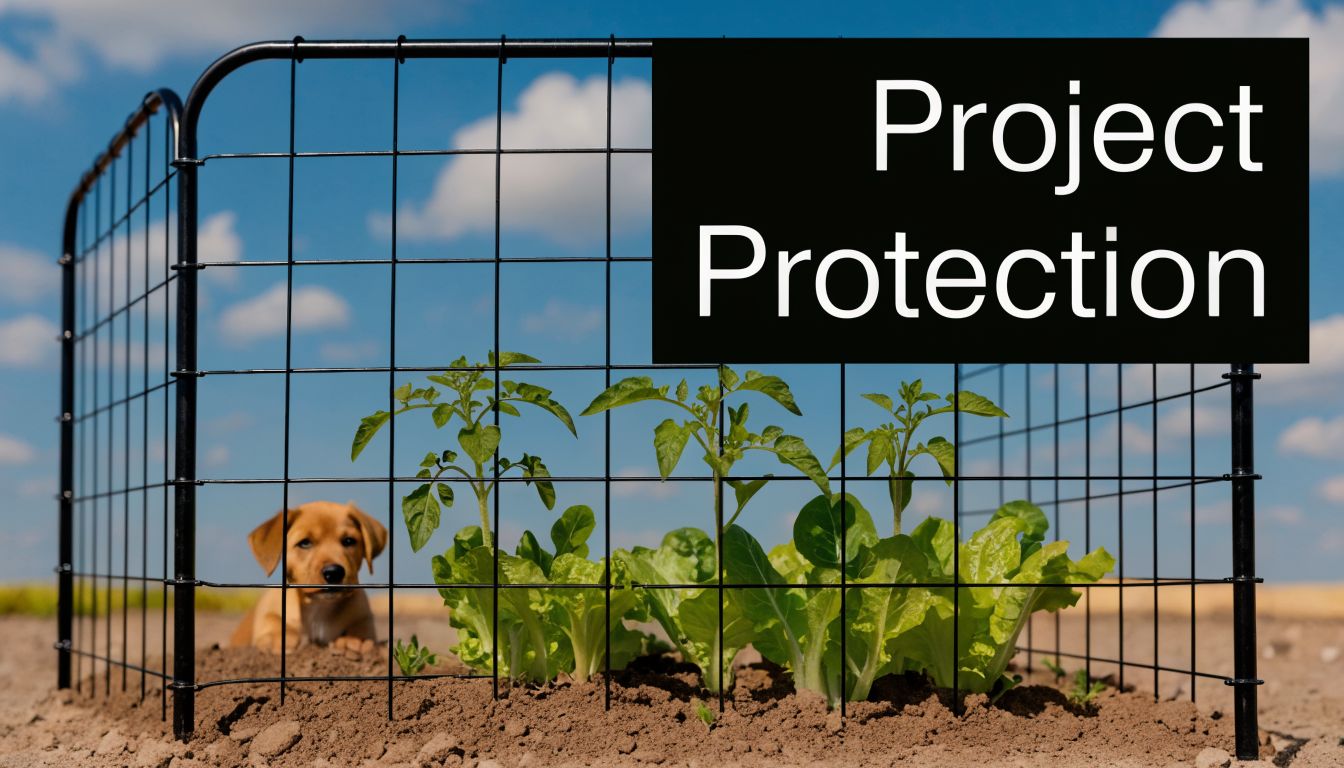
You’re probably looking at one of three jobs right now. A garden needs protection before rabbits find it. A new puppy needs a safe run that doesn’t feel like a cage. Or a property line needs a fence that’s clear, tidy, and durable without the bulk and cost of heavier ornamental systems.
That’s where welded wire fence material earns its place. It’s simple, adaptable, and far stronger than many buyers expect when they first see it in a roll or panel. Used well, it can work for gardens, pet enclosures, farm boundaries, utility areas, and clean modern residential fencing. Used badly, it can sag, corrode early, or fail at the welds long before the posts do.
The difference usually comes down to four decisions. The wire itself. The coating. The gauge and mesh opening. And the hardware that ties the whole system together. If you get those four right, welded wire stops being “just mesh” and becomes a complete fence system that lasts.
Your Guide to Choosing Welded Wire Fencing
A lot of people start with the wrong question. They ask, “What’s the cheapest wire fence I can put up?” The better question is, “What does this fence need to do every day?”
A back garden fence for a small dog needs different qualities than a vineyard perimeter or a side-yard divider near the coast. One job needs small openings. Another needs heavier wire. Another needs a finish that won’t give up when fog and salt keep the metal damp.
What makes welded wire so useful is that it sits in the middle ground between light, temporary solutions and more expensive heavy perimeter systems. You get visibility, airflow, and a cleaner profile than many traditional field fences. You also get a product with real history behind it, not a recent trend dressed up as innovation.
Welded wire fencing evolved from late 19th-century innovations, with a key 1889 patent for a machine that welded steel wires into panels. By the early 20th century, electro-galvanized welded wire mesh became standard for its strength and corrosion resistance, offering a superior alternative to stretching smooth wire, as noted in this historical perspective on welded wire mesh.
What clients usually want from it
Most buyers aren’t looking for a technical lecture. They want a fence that does a few basic things well:
- Keeps animals where they belong
- Stops pests from getting into planted areas
- Marks a boundary without blocking the view
- Looks organised instead of improvised
- Holds up without constant repairs
Those are reasonable goals. Welded wire can meet them, but only when the specification matches the site.
Practical rule: Start with the use case, not the catalogue photo.
If you’re choosing welded wire fence material for a real project, think like a contractor would. What hits the fence. What leans on it. What soaks it. What the posts are made from. And whether you want this to last a season or stay in place for years without becoming a maintenance chore.
Understanding the Core Components of Welded Wire
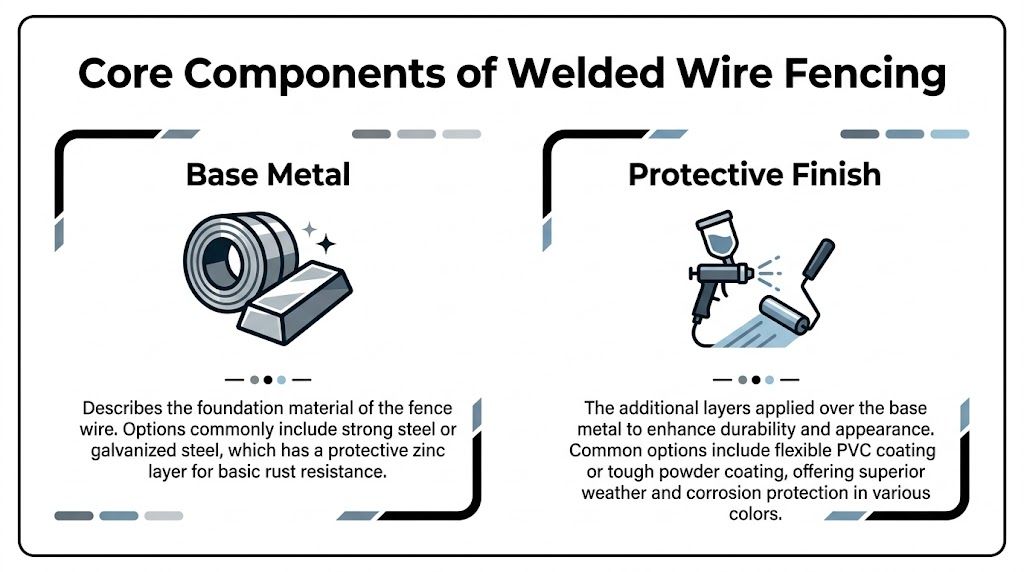
Most buying mistakes happen because people treat welded wire as one product. It isn’t. It’s a combination of base metal and protective finish, and each choice changes how the fence performs.
Base metal matters more than most buyers think
For many fence jobs, steel is the working material. It’s practical, available in a wide range of gauges, and suits both rolls and rigid panels. For everyday garden, residential, and agricultural use, steel usually makes sense because it gives good structural value without forcing the project into a premium budget.
Stainless steel sits in a different category. It’s the choice for harsh exposure, long-term corrosion resistance, or specialised industrial and architectural work. It costs more, so it usually only makes sense when the environment justifies it.
That’s the first trade-off. Standard steel is the workhorse. Stainless is the premium option when rust risk is the main enemy.
The finish is the fence’s raincoat
The finish determines how well the wire survives weather, irrigation, and coastal exposure. Consequently, many fences look fine on delivery day and disappointing a few years later.
A useful way to think about coatings is this:
| Option | Best suited to | Main trade-off |
|---|---|---|
| Standard galvanized | General inland use | Less forgiving in harsher coastal conditions |
| Hot-dip or heavier galvanized systems | Tougher outdoor exposure | More cost than basic galvanized |
| PVC-coated wire | Residential, pet, garden, and visible installations | Slightly bulkier look, but better long-term finish retention |
| Stainless steel | Severe corrosion exposure or specialised work | Highest material cost |
In diverse climates like those in California, from coastal fog to inland dryness, the choice of coating is critical. Regional data shows that standard galvanized mesh can fail 20-30% faster in coastal areas with high salt exposure compared to PVC-coated or stainless steel options, reducing a 10-year lifespan to just 5-7 years without the proper protection, according to this overview of welded wire fence advantages and disadvantages.
Where the common finish types fit
You’ll often hear installers and suppliers talk about three practical categories.
- Galvanized before welding tends to be the budget-minded route. It can work for lighter-duty jobs, but the vulnerable point is the weld area.
- Galvanized after welding usually gives better protection at intersections, where many fences begin to show trouble first.
- PVC-coated welded wire adds another defensive layer and often looks better in residential settings, especially in black or green.
That doesn’t mean every garden needs a premium finish. It means the finish should match the site.
If the fence lives near salt air, sprinkler overspray, or constant damp shade, the coating isn’t a detail. It’s the life expectancy.
Think in systems, not pieces
A fence rarely fails because one brochure number looked bad. It fails because the specification was unbalanced. Heavy wire with poor coating can disappoint. Good coating on undersized wire can still bend. Strong mesh attached with weak fasteners creates another weak point.
When buyers understand the base metal and the finish as a pair, they usually make better decisions. That’s the point where welded wire fence material stops being a commodity and starts being a proper specification.
Decoding Gauge and Mesh Size for Your Project
Gauge confuses a lot of buyers because it works backwards. A lower gauge number means thicker wire, and thicker wire usually means a stiffer, stronger fence.
That matters because many fencing problems aren’t really “fence” problems. They’re specification problems. The wire was too light for the pressure it had to take, or the openings were too large for the job.
Read gauge like a strength scale
If you’re comparing a heavier agricultural mesh to a light garden roll, don’t expect them to perform the same way just because both are called welded wire. A light gauge may be perfectly fine for guiding plants or discouraging small pests. It won’t behave the same way when dogs, wildlife, or people press against it.
For professional use in agricultural settings, 12.5-gauge galvanized welded wire with a 2"x4" mesh is an industry benchmark. With a weld shear strength over 400 lbs and wire tensile strength exceeding 60,000 psi, it can withstand impacts from animals like coyotes, while lighter 16-gauge alternatives often fail, as detailed in this welded wire mesh fence specification sheet.
Mesh size changes what the fence can do
Mesh size is the opening between the wires. That one detail affects containment, appearance, safety, and climbing behaviour.
A small opening does a few useful things. It blocks smaller animals, supports climbing plants better, and makes it harder for pets to squeeze through. A larger opening uses less material, looks lighter, and often suits larger animal containment or broad boundary runs.
Here’s the practical way to consider it:
- Small mesh openings suit garden protection, pet safety, and areas where you need to stop smaller intruders.
- Mid-size openings often work well for general residential boundaries and mixed-use yards.
- 2"x4" mesh is a familiar choice for agricultural and utility work where visibility and strength both matter.
- Large openings with light wire are where buyers often regret trying to save money.
Match the wire to the pressure
The fence doesn’t care what the label says. It only reacts to force. Ask what will happen on a busy day, not an ideal day.
- Pets running the line: Use a wire and opening that resists repeated impact and doesn’t invite paws or heads through weak spaces.
- Garden beds: Smaller openings usually matter more than maximum wire thickness.
- Rural perimeter work: Heavier wire pays for itself because the fence takes real hits.
- Decorative screening: Appearance and finish may matter more than brute strength.
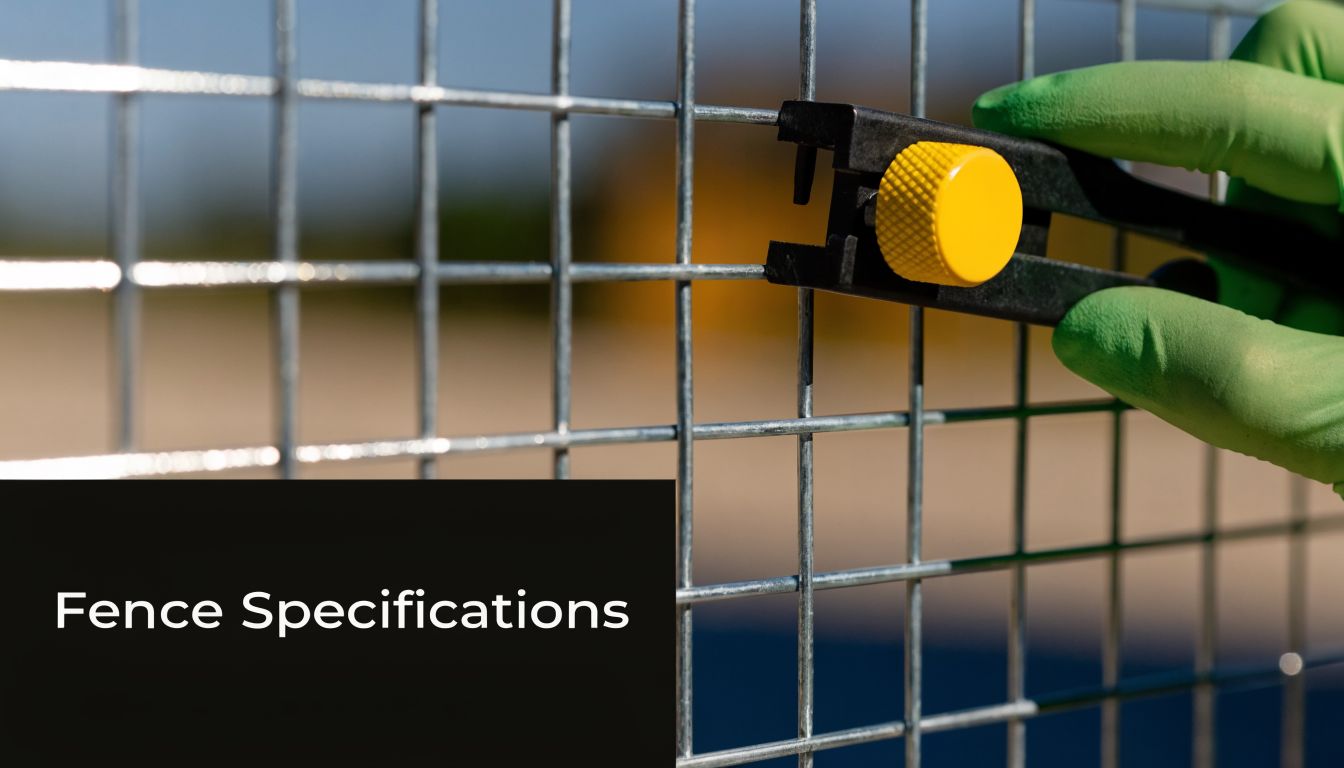
A quick visual can help if you’re sorting through dimensions and roll specs:
One common buying error
People often choose by price per roll instead of price per useful service life. That’s where too-light material sneaks onto jobs it was never meant for.
Buy the lightest welded wire fence material that still suits the job. Don’t buy lighter than that.
That approach keeps the project sensible without setting it up to fail. If the fence only needs to guide plants, don’t overspend. If it needs to stop a determined dog or hold a boundary in a rural setting, don’t pretend decorative mesh is a structural choice.
Common Applications and Welded Wire Fence Ideas
Welded wire works because it crosses between utility and appearance better than many fencing materials. It can look clean enough for a front garden screen and practical enough for a paddock divider.
Residential gardens and pet areas
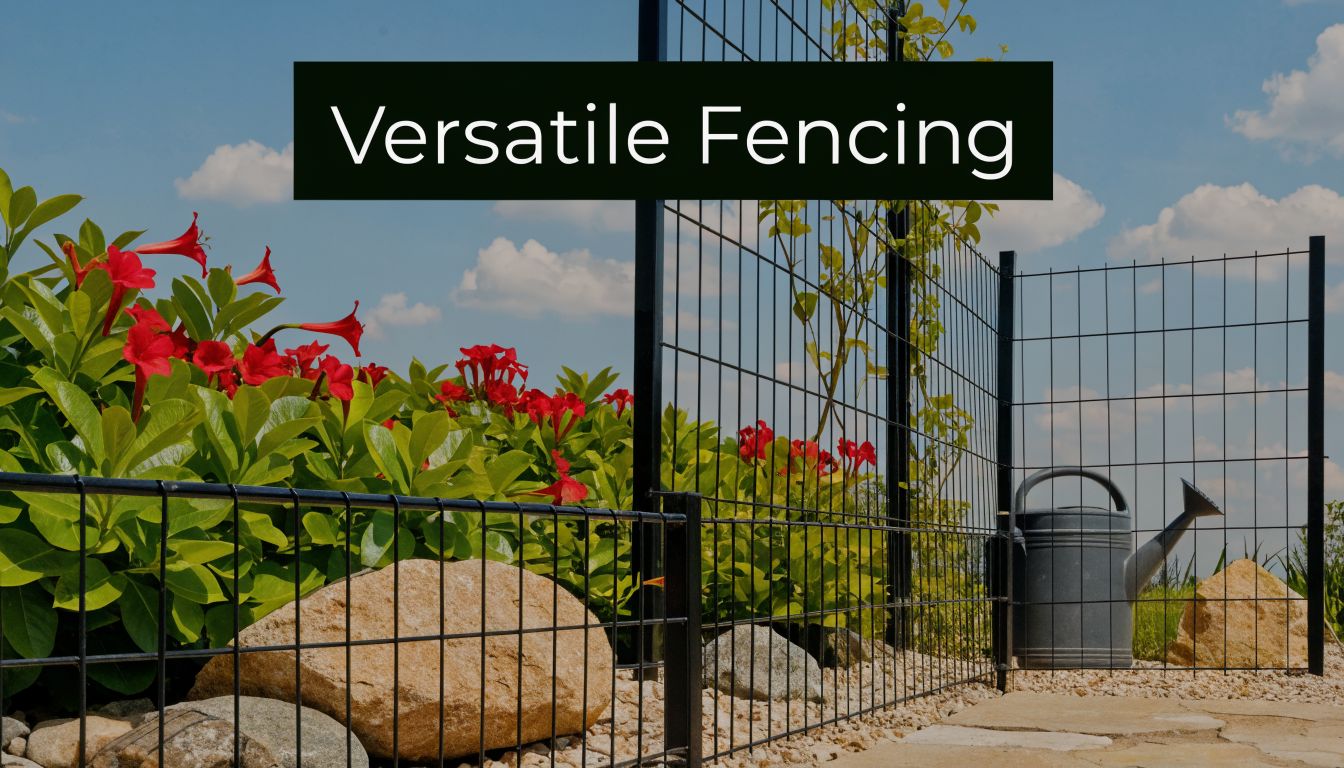
For homes, the strongest use case is often the simplest one. You want security without visual heaviness. Black or green PVC-coated welded wire usually blends more effectively into the setting than bare metal, and it pairs well with timber posts, metal frames, or simple gates.
A kitchen garden benefits from smaller mesh that keeps out unwanted visitors while still letting light and air through. A pet enclosure needs enough rigidity that the wire won’t distort after repeated contact along the run.
Farms and acreage
On larger properties, welded wire often gets chosen because it’s more orderly and predictable than looser alternatives. It’s useful where visibility matters, where boundaries need to stay clear, and where a cleaner line is worth the extra care in specification.
For broader agricultural ideas and perimeter planning, it helps to review examples of farm fencing options and layouts. The key is still the same. Match heavier wire and practical mesh openings to the actual animal pressure and site exposure.
Commercial and utility spaces
Commercial sites often need a fence that reads as secure and organised without becoming visually dominant. Welded wire panels can suit service yards, equipment screening, and demarcation around shared-use areas.
What works well in these settings is consistency. Straight runs. Proper post alignment. Gates that don’t sag. Mesh that matches the frame instead of looking like a retrofit.
A few combinations tend to work well:
- Modern boundary: Black coated mesh with dark posts and simple cap details.
- Garden feature screen: Narrow framed welded wire supporting climbers.
- Dog run: Smaller opening mesh with a rigid gate frame.
- Utility enclosure: Galvanized or coated wire with durable latch and hinge setup.
The best-looking welded wire fence usually isn’t the fanciest one. It’s the one where the mesh, posts, gate, and hardware all belong together.
That’s why application matters more than trend. The same material can look refined in one project and makeshift in another, depending on whether the details were chosen as a complete system.
A Contractor's Guide to Specification and Ordering
A fence specification sheet tells you whether you’re buying a durable system or a problem in neat packaging. Contractors learn to read these sheets fast because the failure points are predictable. Welds, coating, wire size, and attachment method.
What to look for on a specification sheet
Start with the standard. Professional-grade welded wire mesh must meet ASTM F2453/F2453M. This specification covers key performance factors such as weld shear strength, metallic coating weight, and polymer coating adhesion. For 6-gauge wire, it often requires over 500 lbs per weld, helping the fence withstand high winds and coastal corrosion, as outlined in this ASTM-based welded wire fence gate specification.
After that, read the sheet in this order:
- Wire gauge first. This tells you whether the fence is built for light-duty or real impact.
- Coating system second. A decent wire with a poor finish can still disappoint.
- Panel or roll dimensions third. Make sure the format suits the site and the installation method.
- Weld quality and test language last. Often, bargain material falls short in this regard.
Order the full system, not only the mesh
A lot of delays happen because the mesh gets ordered first and everything else gets guessed later. That usually leads to mixed finishes, wrong fastener lengths, or gate hardware that doesn’t match the post size.
For a smoother buying process, list the whole job before placing the order:
| Item | Why it matters |
|---|---|
| Mesh or panels | Core fence body |
| Line, end, and corner posts | Structural support |
| Post caps or tops | Finish and weather protection |
| Fasteners and staples | Attachment integrity |
| Gate frame and hinges | Daily function |
| Latches and stops | Security and alignment |
| Anchors or brackets if needed | Site-specific fixing |
Contractors who want one place to source those finishing details often browse fence and gate hardware selections before finalising takeoffs, especially when the project needs hinges, post caps, brackets, or fasteners that match the rest of the build.
A simple takeoff habit that prevents mistakes
Measure the site in runs, not rough totals. Mark every corner, end, gate opening, grade change, and termination. Then count hardware by connection point, not by “a box should do it”.
Order for the fence you’re building on the ground, not the straight line you drew on paper.
That habit saves time because fences rarely fail in the middle of an easy straight run. They fail at corners, at gates, and where installers had to improvise.
Installation and Long-Term Maintenance Tips
Good welded wire fence material can still underperform if the installation is careless. Most field problems come from poor post setting, over-tensioning, weak attachments, or mixing corrosion-resistant mesh with low-grade fixings.
Set the line before you touch the mesh
Posts control the finished look. If the line wanders, the mesh will only make it more obvious. Set corners and ends first, establish your string line, and make sure the gate opening is square before the wire comes off the roll.
If you’re working through post layout and setting methods, a practical reference on how to install fence posts helps avoid the usual alignment mistakes.
Don’t over-tension welded wire
This is one of the most common DIY errors. People install welded wire as if it were woven field fence and pull too hard trying to make it “banjo tight”. Welded wire needs to be straight and well-supported, but excessive force can stress the welds and create premature failure.
Use controlled tension. Pull enough to remove slack and maintain line, but let the posts and regular fastening do the long-term work.
A few installation habits consistently produce better results:
- Use the right post spacing: Wide spacing may save materials, but it asks more of the wire and fasteners.
- Fasten at consistent intervals: Random attachment points lead to ripples and weak sections.
- Support grade changes properly: Don’t force a rigid panel or welded section to follow uneven ground without planning the transition.
- Build the gate area stronger: The gate line takes repeated movement and needs better support than a simple run.
Protect the connection points
Even when the mesh is specified properly, attachment points often become the weak spot. Staples, screws, washers, brackets, and hinge fasteners all live at stress points. If they corrode early or loosen under movement, the fence starts to fail from the edges and openings.
That’s why matching corrosion resistance across the system matters. If the wire is coated for a harsher environment, the hardware should be chosen with the same mindset.
A fence doesn’t last because one component is strong. It lasts because the vulnerable points were treated seriously.
Use a simple yearly maintenance check
Welded wire is relatively low-maintenance, but “low-maintenance” doesn’t mean “ignore it forever”. One inspection round each year catches most issues before they become repairs.
Use a checklist like this:
- Walk the full perimeter: Look for sagging, leaning posts, or mesh distortion.
- Inspect weld areas and cut ends: Surface trouble often begins where protection is weakest.
- Check gate movement: A dragging or misaligned gate puts extra strain on the nearest section.
- Rinse and clean where needed: Coastal residue, irrigation deposits, and soil splash should not be left to sit indefinitely.
- Tighten or replace fixings: Loose hardware spreads movement into the surrounding fence line.
Where maintenance effort changes by finish
PVC-coated welded wire generally asks less of the owner in visible residential settings because it resists the tired, patchy look that develops as exposed metal ages. Galvanized wire can perform very well in the right environment, but it rewards periodic inspection, especially around welds and fastened points.
In practice, the easiest fence to live with is the one that matched the site from day one. Correct wire. Correct finish. Correct post system. Correct hardware.
Making the Right Welded Wire Choice for Your Project
The best welded wire fence material isn’t the heaviest roll on the shelf or the cheapest option online. It’s the one that suits the job without forcing you into unnecessary cost or future repairs.
Start with purpose. Decide whether the fence is for pets, garden protection, boundary marking, agricultural use, or a cleaner commercial perimeter. Then choose the material and finish based on the site conditions. Coastal exposure, damp shade, and regular irrigation push you toward better corrosion protection. Lighter inland use gives you more flexibility.
After that, choose gauge and mesh size based on pressure. Small pests, active dogs, livestock, and decorative screening all ask different things from the wire. Finally, finish the system properly with posts, gates, and fixings that belong with the mesh rather than merely attaching to it.
That’s the practical value of welded wire. It can be economical, neat, and long-lasting, but only when the whole build is specified as one system.
Frequently Asked Questions About Welded Wire Fencing
Can you paint welded wire fencing
Yes, but preparation matters. The surface has to be clean, stable, and suitable for coating. If the wire already has a finish in good condition, painting may be more about appearance than protection. If corrosion has already started, paint won’t fix poor underlying metal.
How does welded wire compare with woven wire
They behave differently. Welded wire is usually neater, more rigid, and better when you want consistent openings and a clean visual line. Woven wire has more flexibility and can suit applications where movement in the fence fabric is useful. If you want a tidy residential or utility look, welded wire often has the edge.
What tools do you need to cut it
For lighter material, hand tools may be enough. For heavier gauges, use tools suited to the wire thickness and wear gloves and eye protection. The cleaner the cut, the easier it is to fasten and frame the end properly.
Is welded wire good for dogs
Yes, if the gauge and mesh opening fit the dog’s size and behaviour. Small openings help prevent squeezing through or getting caught. Active or heavier dogs need stiffer wire and a properly braced gate area.
Is galvanized enough, or should you choose coated wire
That depends on the environment. Inland sites with lower moisture exposure can do well with galvanized material. Coastal or persistently damp locations usually justify a better protective finish.
What usually fails first on a welded wire fence
In real installations, the first problems often show up at welds, cut ends, gates, corners, and attachment points. That’s why careful installation and compatible hardware matter as much as the mesh itself.
XTREME EDEALS INC. makes it easier to finish a welded wire fence properly with the parts that often get overlooked until the last minute. If you need post caps, hinges, latches, brackets, carriage bolts, lag bolts, screws, anchors, or other fence and gate hardware, browse XTREME EDEALS INC. for practical accessories that help turn good welded wire fence material into a complete, durable system.