

You’re probably at the stage where the deck frame is done, or the old railing has come off, and now the details suddenly matter. The railing isn’t just a finishing touch. It decides how open the deck feels, how safe it is for kids and guests, and whether the whole project looks sharp or pieced together.
That’s where nuvo iron balusters make sense for a lot of projects. They let you keep the warmth of wood rails while replacing bulky wood spindles with something cleaner, straighter, and easier to style around the house. For homeowners planning a full deck refresh, it also helps to look at the railing as part of the larger layout. If you’re still shaping the whole outdoor space, this overview of custom deck design and build shows how the railing choice fits into the deck’s footprint, stairs, traffic flow, and finished look.
Transform Your Deck with Modern Iron Balusters
A standard wood deck can feel heavy fast. Thick posts, wide rails, and closely grouped wood spindles often block the view and make the space look older than it is. Swap in iron balusters, and the same deck usually feels more open, more current, and better proportioned.
Nuvo Iron sits in a useful middle ground for real projects. You’re not building a custom welded metal guard from scratch, but you’re also not settling for flimsy decorative parts that only look good in the box. These balusters are meant for practical deck work, especially when you want to reuse or build wood top and bottom rails and still get a more refined finish.
Start with the project, not the catalogue
The right choice depends on what you’re trying to solve.
- Safety first: If the deck is raised, around children, or tied to a stair run, spacing and connector choice matter more than decorative profile.
- Appearance: A simple square baluster suits a modern build. A twist or basket profile can soften a more traditional façade.
- Budget control: Reusing existing rails can keep material costs and labour more manageable than a full railing replacement.
- Climate exposure: Outdoor metal needs to handle moisture, sun, snow, and road salt drift, especially in Canadian conditions.
The best railing package is the one that fits the deck you actually have, not the one that looks nicest in a showroom photo.
A good baluster decision balances all four. If one gets ignored, the railing usually ends up being the part of the project people want to redo later.
Understanding Nuvo Iron's Superior Construction
The reason many contractors and experienced DIYers look closely at Nuvo Iron isn’t just style. It’s the way the baluster is built. The material stack-up matters outdoors, especially when the railing sits through wet springs, hard winters, and strong summer sun.

What the baluster is made from
Nuvo Iron square and rectangular balusters are made from heavy-gauge galvanized cold-rolled steel. That matters because steel gives the baluster its backbone, and galvanization adds a protective zinc coating before the finish goes on top. According to Nuvo Iron’s product sheet, these balusters have flexural strength exceeding 500 MPa, compared with typical aluminum balusters at around 200 MPa, which is more than 2.5 times the strength. The same document ties that strength to residential guardrail requirements of 1.5 kN/m uniform deck loads under the Ontario Building Code in the Nuvo Iron square baluster specifications.
That’s the practical difference between a railing that feels firm and one that starts to feel light or springy once it’s installed.
Why galvanizing and powder coating both matter
A lot of people hear “powder coated” and stop there. Powder coating is important, but it’s only part of the protection. It's comparable to outdoor workwear. The visible outer shell handles abrasion, weather, and UV. The base layer underneath is what keeps damage from turning into early failure.
With Nuvo Iron, the steel is galvanized first, then finished. In plain terms, that gives you a backup line of defence if the surface ever gets nicked during handling or installation. That layered approach is more practical outdoors than untreated steel, and it’s one reason these balusters make more sense than indoor-style decorative metal parts repurposed for a deck.
How it compares with other railing infill options
Wood spindles have one advantage. They’re familiar. But they also need more upkeep, and they visually thicken a railing fast. Aluminum is lighter, which can help in some applications, but lighter isn’t automatically better for every deck.
Here’s how the trade-off usually looks on site:
- Wood balusters: easy to match with all-wood rails, but bulkier in appearance and more maintenance-heavy over time.
- Aluminum balusters: lighter and common in the market, but not as strong on the flexural numbers cited above.
- Nuvo Iron steel balusters: stiffer feel, crisp profile, and a finish system built for exterior use.
Practical rule: On an exposed deck, I’d rather install a baluster with enough rigidity to stay visually straight and feel solid after seasons of use than save a little weight and accept more movement.
Choosing Your Baluster Style and Finish
Once the construction side checks out, style becomes the next real decision. Many people often get stuck at this point, because every baluster can look good on its own. The part that matters is whether it fits the house, the rail design, and how formal or simple you want the deck to feel.
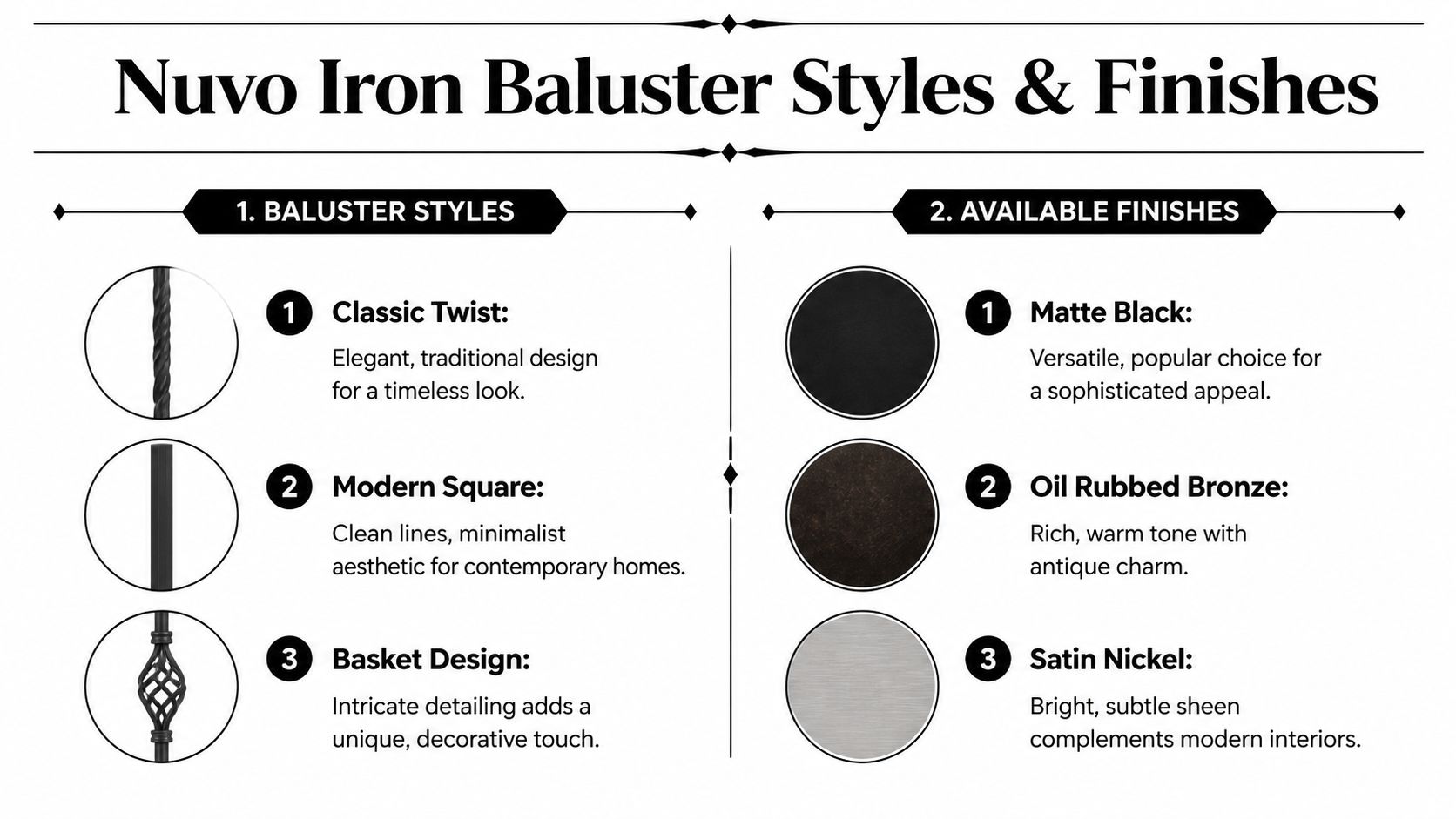
Match the profile to the house
A clean-profile baluster works best when the deck is supposed to disappear into the architecture. A decorative baluster works best when the railing is meant to be seen.
| Style | Best For | Aesthetic Feel |
|---|---|---|
| Modern Square | Contemporary homes, simple deck lines, composite or stained wood rails | Clean, architectural, restrained |
| Classic Twist | Traditional homes, porches, transitional exteriors | Formal, familiar, decorative without being busy |
| Basket Design | Older homes, feature decks, accent sections | More ornate, more visual presence |
Square balusters are the safest choice if you’re unsure. They pair well with black hardware, cedar-tone rails, pressure-treated lumber once stained, and most modern siding palettes. They also tend to make the railing feel less cluttered.
Twist and basket styles are better when the deck sits on the front of the house or where the railing is part of the curb appeal. Used sparingly, they add character. Overused, they can start to fight with the architecture.
Finish matters more than people expect
Most buyers focus on shape first, but finish usually decides whether the railing looks coordinated. Matte black is easy to live with. It works with white trim, warm wood, charcoal siding, and mixed exterior hardware. If your project includes other dark accents, it almost always ties in cleanly.
Oil rubbed bronze and satin nickel can suit certain homes, but they need more deliberate coordination. Bronze feels warmer and more traditional. Satin nickel reads brighter and cleaner, often in more contemporary settings. If the rest of the deck hardware is dark, dropping in a light metallic baluster can look accidental.
Pick for the environment, not just the sample
Nuvo Iron’s galvanized steel balusters use a powder coating engineered to resist UV degradation by 95%, and the product line is positioned for corrosion resistance in high-humidity and salted-road conditions common in Canada. The same product background also notes SMSRA Surface Mount Stair Railing Adapters for 3/4-inch round balusters sold in 20-packs, along with a 15% rise in deck upgrades in Ontario post-2020 in the Nuvo Iron durability and retrofit overview. For a homeowner, the practical takeaway is simple. The finish isn’t only decorative. It’s part of whether the railing still looks right after real weather exposure.
What usually works best
A few combinations tend to work reliably:
- Black square balusters with natural or medium-stain wood rails: clean and current without looking cold.
- Twist balusters with painted white or dark rails: better for more classic homes where a plain square rod may feel too minimal.
- Decorative accents mixed into mostly simple balusters: useful if you want a focal point but don’t want the entire run to feel busy.
If your deck already has strong visual elements, keep the baluster simple. If the deck structure is plain, the baluster can carry more of the design load.
Meeting Building Codes and Spacing Requirements
This is the part you can’t guess at. A railing can look perfectly straight and still fail inspection if the spacing is wrong. In practice, spacing is where a lot of deck projects go sideways, especially when people buy by eye instead of laying out the full run on paper first.

The code issue most homeowners need to know
For Canadian residential decks, one of the core spacing rules is that the opening between balusters must stay under 4 inches (100 mm). Nuvo Iron round balusters are designed for a maximum clear spacing of 3-7/8 inches, and their 10-baluster packs are set up to cover about 4 linear feet with that spacing according to the Nuvo Iron stamped wood railing drawing.
That matters because it takes some of the layout guesswork out of ordering. You’re not starting from a blank page and hoping your cut list lands in a code-compliant pattern.
A simple way to plan your count
The practical formula provided in Nuvo Iron’s product guidance is:
(Railing length / spacing between balusters) – 1
That formula assumes end posts are present. It gives you a planning baseline, but don’t stop there. You still need to verify the final clear opening across the finished panel.
For a clean planning process:
- Measure the actual rail section between posts, not the full deck edge.
- Choose the baluster profile before layout, because profile and connector style affect the final look.
- Lay out centres evenly so the field looks balanced, not crammed at one end.
- Check the clear gap, not just the centre spacing.
- Reconfirm stair sections separately, because angled runs need their own adapter and layout.
If you want a more detailed walkthrough on calculating layout, this guide on spacing deck balusters is a useful companion when you’re marking rails.
Where people get into trouble
The most common mistakes aren’t complicated. They’re rushed.
- Using rough framing measurements: rail sections often finish shorter than the original plan.
- Forgetting connector offsets: the hardware affects where the baluster lands.
- Trying to “make the pack fit” on an odd span: that can leave you with a final gap that’s too large.
- Treating stairs like level rails: they are not the same layout problem.
A railing passes because the finished opening works, not because the parts list looked close enough.
If your deck has multiple sections, count each run separately. Don’t average them together and assume the leftovers will sort themselves out. That’s how people end up making last-minute spacing compromises they shouldn’t make.
Planning Your Installation Project
A smooth installation starts before the first pilot hole. The people who say a baluster install was straightforward usually did the prep work. The people who say it was frustrating often started cutting and drilling before they’d settled the rail heights, connector types, and exact layout.

Check compatibility before you order
Nuvo Iron balusters are a good fit when you’re using wood top and bottom rails or retrofitting an older railing frame that’s still structurally sound. The first question isn’t which baluster looks best. It’s whether the rails and posts you’re attaching to are straight, secure, and worth keeping.
Before ordering, confirm:
- Rail material: wood and composite-clad systems need different handling during layout and fastening.
- Rail thickness: make sure the connector system suits the rail dimensions you’re building with.
- Stair angle: stair runs need the correct adapter, not the same connector used on level sections.
- Post spacing: wider spans affect how the finished section feels and how carefully the layout must be centred.
If any part of the railing frame is loose, rotted, or undersized, fix that first. Balusters don’t rescue a weak railing assembly.
Tools that make the job cleaner
This isn’t a tool-heavy job, but accuracy matters.
A practical setup includes:
- Tape measure and pencil: for repeatable layout marks.
- Speed square or combination square: to keep marks consistent on rails.
- Drill or driver: for fastener installation.
- Level: especially useful when setting level rail sections before infill goes in.
- Clamps: to hold rails or jigs in place during layout.
- Fine marker or layout jig: to reduce cumulative spacing errors.
Good prep usually saves more time than fast drilling.
Choose the right package size
For larger sections, contractor packaging can make the material list cleaner. Nuvo Iron contractor value packs often include 30 balusters and 60 connectors, designed to cover 12 linear feet for standard 36-inch high Canadian decks, and this packaging can reduce material waste by 20-30% compared with individual purchases according to Nuvo Iron’s baluster FAQ.
That’s useful when you have several identical sections, a long deck perimeter, or matching stair and level runs. Smaller projects may still be better served by standard packs because they give you more flexibility if your lengths vary.
Connector choice changes the whole install
Face-mount and stair adapters aren’t interchangeable in practice. Use the one designed for the application.
- Straight rail connectors: best for level runs where top and bottom rails are parallel.
- Stair adapters: needed where the baluster follows an angled rail line.
- Surface-mount systems: often speed up installation because they avoid awkward toe-nailing or improvised attachment methods.
For a broader look at rail assembly and attachment details, this article on how to attach deck railing is worth reading before you start.
After the layout is confirmed, a video can help clarify the sequence of the work.
What works on site and what doesn’t
A few habits make these installs go better:
- Dry-fit one section first: prove the spacing and connector orientation before repeating it across the deck.
- Build a simple spacing jig: repeated measuring is where small errors stack up.
- Sort parts by section: don’t open every pack and mix stair hardware with level-run hardware.
- Keep the cuts and drilling controlled: rushing the visible parts of the railing always shows in the finished work.
What doesn’t work is improvising the layout as you go. Balusters look simple, but railing work rewards precision. A half-hour spent planning often saves a full afternoon of rework.
Long-Term Maintenance and Finish Care
Homeowners ask the same question once the railing is in. How does it hold up after real winters, not just after installation day? That concern is valid, and it’s one of the least-addressed parts of many product pages.
Questions about rust resistance and performance over 10+ years come up often for Ontario homeowners, especially where freeze-thaw cycles are harsh. The practical guidance tied to Nuvo Iron’s steel construction is that proper maintenance, combined with galvanized steel and powder coating, is key to preventing problems in those conditions, as reflected in these customer concern notes on long-term degradation.
What to watch after installation
Most finish problems start at vulnerable points, not in the middle of a baluster. Check the connectors, fastener locations, and any area that may have been scratched during cutting or handling. Dirt and trapped moisture around those spots deserve attention.
A sensible care routine looks like this:
- Wash the railing periodically: mild soap and water are usually enough for surface dirt.
- Inspect connection points: look for finish damage, debris build-up, or signs of standing moisture.
- Touch up damage early: don’t leave exposed areas unattended through a full season.
- Keep runoff in mind: planters, sprinkler overspray, and trapped snow can all increase moisture exposure.
What works and what doesn’t
What works is simple maintenance and careful installation from day one. What doesn’t work is assuming any coated metal should be ignored forever just because it’s rated for exterior use.
Small finish damage is easier to manage early than after moisture gets time to work into the weak spot.
If you want a broader read on protecting exposed metal parts outdoors, this expert guide on metal protection adds useful maintenance context.
How to Buy Nuvo Iron Balusters from Xtreme eDeals
Buying the right balusters gets easier when you treat the order like a project takeoff, not a style-only purchase. Start with your measured rail sections, separate level runs from stair runs, and decide whether you’re buying for a small repair, a single deck face, or a full perimeter.
The next step is matching the package to the project. Smaller sections are easier to handle with standard packs. Longer runs or repeated sections often justify contractor packaging because the baluster and connector counts line up more efficiently. If your project also includes related hardware, XTREME EDEALS INC. carries deck and fencing accessories, fasteners, post caps, balusters, gate inserts, hinges, and brackets in the same catalogue, which can simplify one-order planning for some jobs.
A practical buying checklist
Use this order sequence before adding anything to cart:
- Confirm your baluster style based on the house and rail design.
- Split stair and level sections so you don’t miss adapter requirements.
- Count each section separately rather than estimating by total deck length.
- Check finish consistency across balusters, connectors, and related hardware.
- Review installation guidance if the project includes gates or matching inserts.
If you want one more install reference before finalising the order, this Nuvo Iron gate insert video guide is useful for understanding how these products fit into a broader railing and gate package.
A good order is the one that arrives complete, matches the project, and doesn’t force substitutions halfway through the build. That’s usually the result of careful measuring, clear section-by-section planning, and choosing parts that fit the deck you’re building.
If you’re ready to choose nuvo iron balusters and the related hardware for your deck or stair project, browse the current selection at XTREME EDEALS INC.. It’s a straightforward place to compare sizes, finishes, and accessory categories in one order workflow.