

A lot of decks look good from inside the house and feel exposed the minute you step onto them. You carry out a coffee, sit down, and realise you're in full view of the neighbour's kitchen, the lane behind the fence, or the second-storey window next door. The deck is usable, but it doesn't feel like somewhere you can properly settle in.
That's usually when homeowners start searching for privacy deck railing ideas and get flooded with photos that skip the hard part. The pictures show clean lines, nice materials, and tidy corners. They rarely show how the panels are supported, what hardware keeps them rigid, or whether the design will pass inspection.
Good privacy railings solve more than one problem at once. They block sightlines, keep the deck safe, suit the house, and hold up through weather without turning into a maintenance chore. The right design also needs the right brackets, screws, anchors, post caps, and connectors. Otherwise even a smart-looking build can end up rattling, sagging, or trapping water where it shouldn't.
Many projects encounter difficulties here. Homeowners pick a look first, then try to force the structure to match it.
Your Private Outdoor Oasis Starts Here
A deck doesn't need to become a walled box to feel private. In most projects, the fix is more targeted than that. One side may need full screening because it faces a neighbour's patio. Another side may only need partial coverage to soften a view without killing light and airflow.
That's the difference between a deck that feels cramped and one that feels protected. Privacy works best when it responds to the way the space is used.
Start with the sightlines
Stand on the deck and note where people can see in from. Do it seated and standing. Those are often two different views.
A few common patterns show up again and again:
- Back-to-back gardens: Usually need stronger privacy on one long side.
- Corner lots: Often benefit from a feature screen rather than full enclosure.
- Raised decks: Need privacy that also respects guard requirements and structural load.
- Townhomes and narrow lots: Usually need screening that preserves light as much as possible.
Practical rule: Build privacy where the eye lands, not everywhere you can physically attach a panel.
Treat it like a build, not a decorating project
The best results come from thinking in layers. First handle code and structure. Then decide how much privacy you want. Then choose the finish details that make it look intentional.
That usually means asking five practical questions before buying anything:
- How private does the deck need to be
- Do you want airflow or full screening
- Will the design be attached to new posts or an existing railing
- How much maintenance are you willing to take on
- Which hardware matches the material and exposure conditions
Once those answers are clear, choosing a style gets easier and the shopping list gets much more accurate.
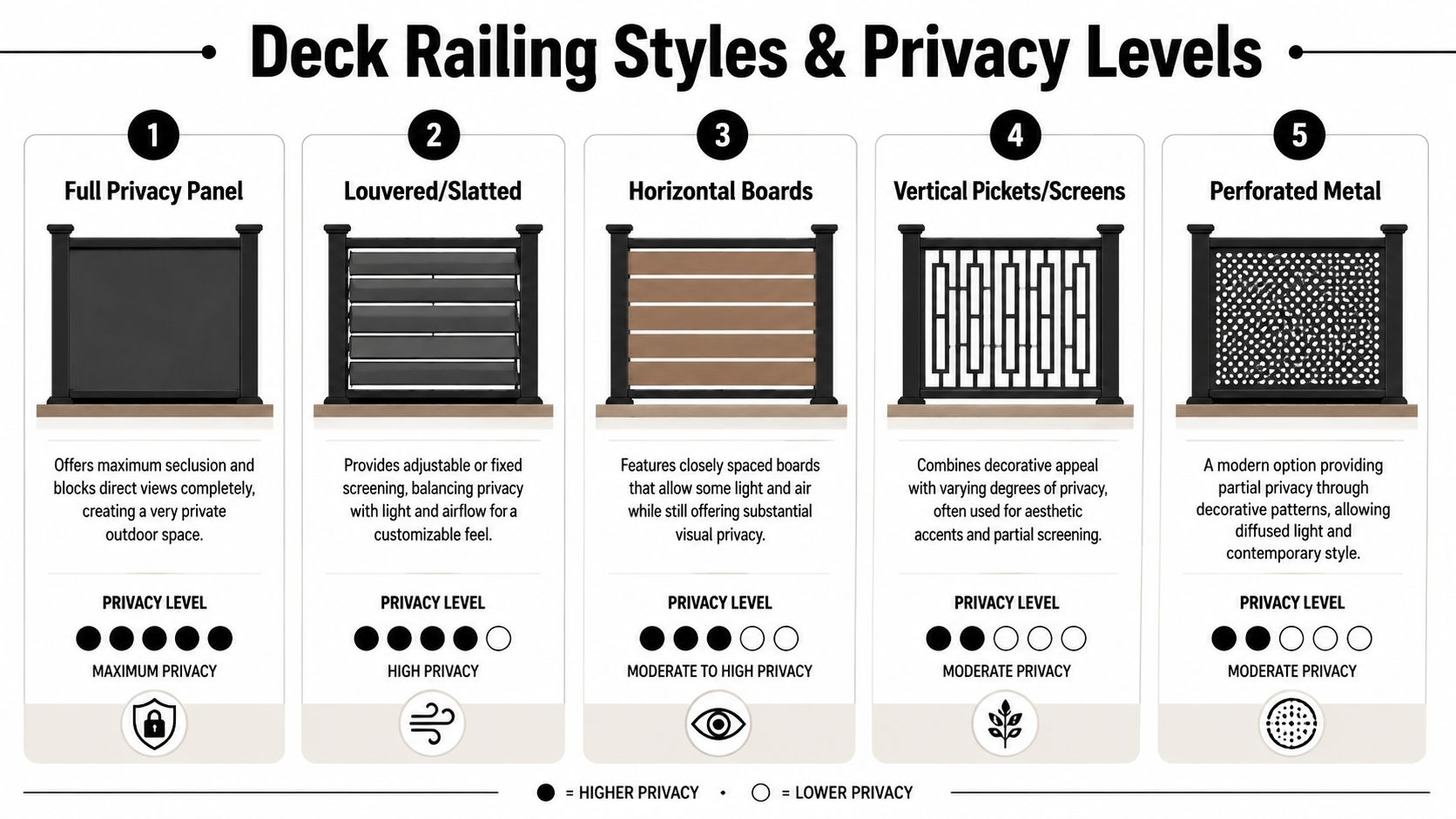
Exploring Deck Railing Styles and Privacy Levels
Privacy railings work like a dial, not an on-off switch. Some designs fully block direct views. Others blur sightlines while still letting in breeze and daylight. That trade-off matters just as much as appearance.
The demand is clearly moving this way. Privacy-focused railings now make up 41% of new deck permits in densely populated urban counties, up from 28% a decade earlier, according to recent deck railing trend data.
For more visual inspiration, this roundup of deck privacy railing ideas is useful when you're narrowing down the look before ordering hardware.
Full privacy panels
Solid panels sit at the high end of the privacy dial. They block direct views almost completely and work well on exposed urban decks, side yards, and raised rear decks facing neighbouring windows.
They also create the biggest structural demand. A full panel catches more wind than an open baluster layout, so post anchoring and frame stiffness matter more here than with a standard guard. If the deck is already breezy, I'd rather build fewer solid sections properly than try to wrap the whole perimeter.
Best use:
- Neighbour-facing sides
- Hot tub decks
- Dining areas where seated privacy matters most
Slatted and louvred screens
Slats are the middle ground that works in more homes than people expect. They give you cover without turning the deck into a closed wall. Horizontal slats feel modern and wide. Vertical slats can look lighter and often suit traditional homes better.
The strength of this style is control. Tight spacing gives more screening. Slightly wider spacing keeps the deck brighter and less enclosed.
A few trade-offs show up in practice:
- Horizontal slats: Strong look, but spacing has to stay consistent or the whole run looks off.
- Vertical slats: Easier to align visually on some retrofits.
- Louvred systems: Good where airflow matters, but the frame and fastener package need careful planning.
Lattice and decorative infill
Lattice still has a place when it's used deliberately. The old mistake was treating it as an afterthought. Painted or framed properly, lattice can soften a deck and support climbing plants without feeling dated.
Decorative metal inserts, laser-cut panels, and patterned infills sit in the same category. They create partial privacy and add character at the same time. These are often the right choice when you want the deck to feel screened, not hidden.
A privacy railing should match the house from the street side and the way the deck feels from the chair side.
Living privacy with planters
Integrated planters and trellis sections work well when you want privacy to feel softer. They're especially useful for corner screens and short return walls near seating areas. The structure still needs to be sound, but the visual effect is less heavy than a continuous solid panel.
What doesn't work well is relying on plants alone for a railing that already feels unsafe or undersized. Greenery is a complement, not a substitute for a proper guard.
Choosing the Right Materials for Your Privacy Railing
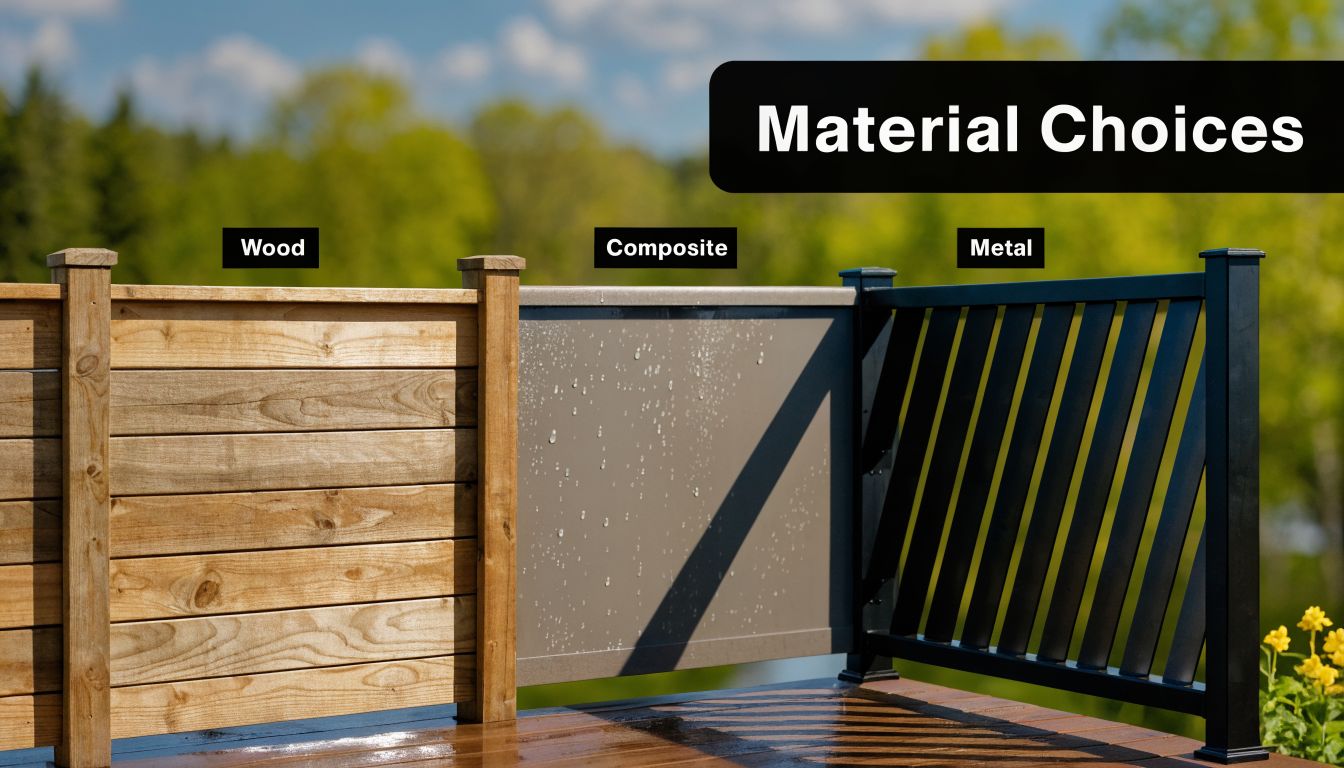
Material choice decides how the railing will age, how often you'll work on it, and how much the finished project costs once installation and upkeep are counted together. Homeowners usually start by comparing appearance. Builders tend to start with weather exposure, fasteners, and how rigid the assembly needs to be.
That's the better order.
In dense housing markets, a well-designed privacy deck can lift resale value by 7 to 12%, while installation costs can range from $15 per square foot for DIY solutions to more than $85 for professionally installed systems, based on privacy deck value and cost guidance. That spread is exactly why material choice needs a hard look before you buy.
Wood
Wood is still the most flexible material for custom privacy deck railing ideas. It's easy to cut, easy to modify on site, and works for lattice, slat walls, framed panels, and planter screens.
It's also the material most likely to punish shortcuts.
If you build in wood, pay attention to end grain sealing, drainage gaps, and fastener compatibility. Standard screws that aren't rated for exterior use can stain the boards or corrode long before the wood itself is done. Wood also moves. That means slatted designs need room for seasonal change or they'll cup, crack, or rub.
Wood is a good fit when:
- You want a painted or stained finish
- You need a custom size or shape
- You're comfortable with ongoing upkeep
Composite
Composite gives a cleaner maintenance profile than wood and works well for homeowners who want a more finished look without annual refinishing. It's often used for privacy boards or screen systems paired with a metal or pressure-treated frame.
The main caution is stiffness. Some composite products look substantial but still need proper intermediate support or a framed system to stay straight. Don't assume a board that works on a deck surface will behave the same way as a vertical privacy infill.
Aluminium and steel
Metal is the practical choice when you want sharp lines, lower maintenance, and a railing that won't feel bulky. Aluminium is especially useful for privacy inserts, framed panels, and decorative screens because it resists corrosion well and keeps the overall assembly lighter than steel.
A black rail with integrated privacy sections is one of the easiest ways to make an older deck look current. If that's the direction you're considering, these black aluminium handrails show the sort of clean profile that pairs well with slats, decorative inserts, and mixed-material screens.
For anyone tying the deck into a broader exterior update, it's also worth looking at Melbourne wall cladding options to see how railing materials can coordinate with stone and feature wall finishes around the same outdoor area.
Hardware matters as much as the panel
The wrong screw can shorten the life of any railing. Coastal exposure, wet timber, and contact between dissimilar metals all change what hardware makes sense. Stainless steel screws and corrosion-resistant structural connectors are usually the safer call for privacy work because these assemblies hold more surface area and often trap more moisture than open guards.
XTREME EDEALS INC. carries practical components for this kind of build, including post caps, post base brackets, balusters, hinges, deck screws, lag bolts, washers, and anchors. That sort of catalogue helps when you want to source the visible finish pieces and the structural fastening hardware from the same place.
Privacy Railing Material Comparison
| Material | Average Cost (per linear ft) | Maintenance Level | Typical Lifespan |
|---|---|---|---|
| Wood | Varies by design and species | Moderate to high | Depends on exposure, finish, and upkeep |
| Composite | Varies by system and support frame | Low to moderate | Long-term performance depends on framing and product type |
| Aluminium | Varies by panel style and finish | Low | Long-lasting with suitable fasteners |
| Steel | Varies by coating and fabrication | Moderate | Durable if coating stays intact |
Build note: Choose the fastener package at the same time you choose the railing material. Waiting until installation day usually leads to mismatched hardware and avoidable call-backs.
Inspiring Designs with XTREME EDEALS Hardware
The easiest way to choose a privacy railing is to think in finished combinations, not loose ideas. A homeowner rarely wants “some privacy”. They want a deck that feels calm at dinner, screened near the spa, or safer and less exposed for kids. Once the goal is clear, the hardware list follows.
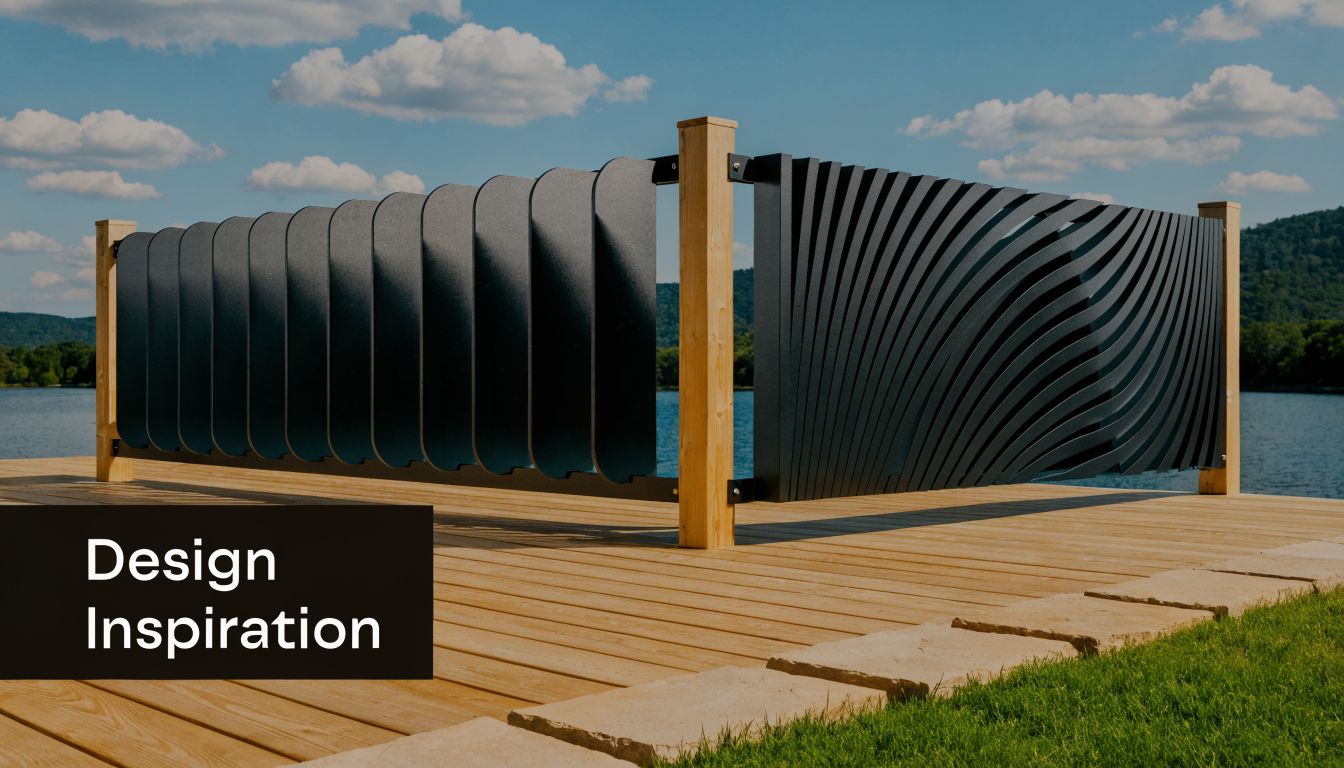
Modern slat screen with a clean top line
This is a strong option for newer homes or any deck that already has a simple rectangular shape. The look comes from evenly spaced horizontal slats held inside a solid perimeter frame, usually with a darker rail colour that makes the infill read as one plane instead of a set of separate boards.
The hardware list matters here because consistency is the whole design. You want:
- Post base brackets that keep the posts plumb
- Structural screws or lag bolts for the primary frame connections
- Weather-resistant deck screws for the slats
- Pyramid post caps to finish the tops cleanly and protect exposed post ends
This style works best when the screen is concentrated where privacy is needed most. Full wraparounds can look heavy unless the deck is large.
Classic framed lattice with better detailing
A framed lattice panel still works well when it's built like a finish element instead of a filler piece. That means proper rails and stiles, equal margins, and trim that gives the panel shadow lines. It suits cottage, traditional, and painted wood homes especially well.
The hardware package is straightforward but important:
- Exterior screws that won't bleed rust into painted trim
- Carriage or lag bolts where rails meet posts
- Gate hinges and matching accessories if one section doubles as an access gate
- Decorative post caps that tie the railing into the rest of the deck
What doesn't work is stapling a thin lattice sheet to the outside of an existing guard and hoping it reads as a finished privacy wall. It usually looks temporary because it is temporary.
Mixed-material screen with decorative metal infill
This is the design I'd use when the homeowner wants privacy without a blank wall. A wood or aluminium frame holds decorative infill panels or semi-private baluster sections. You still get screening, but the deck keeps more light and visual texture.
Decorex Hardware parts are useful in this category because they let you build a custom-looking section without fabricating every detail from scratch. Matching post caps, balusters, and metal inserts make the finished assembly feel cohesive instead of patched together from unrelated pieces.
A short installation video can help if you're comparing screen layouts and fastening methods before ordering parts.
A practical shopping mindset
When homeowners buy privacy railing parts one item at a time, they often miss small pieces that hold up the whole job. The common omissions are washers, post anchors, the correct screw coating, and finishing details like caps or finials.
A more reliable approach is to build your list in four groups:
Structure
Posts, brackets, anchors, structural screws, bolts.Infill
Slats, lattice, panels, decorative inserts, balusters.Finish hardware
Post caps, trim pieces, gate hardware, matching accessories.Site-specific extras
Corrosion-resistant fasteners, replacement anchors, blocking material, shims.
Buy the hidden hardware with the visible hardware. The finish only looks good if the frame underneath stays tight.
Key Installation and Retrofitting Considerations
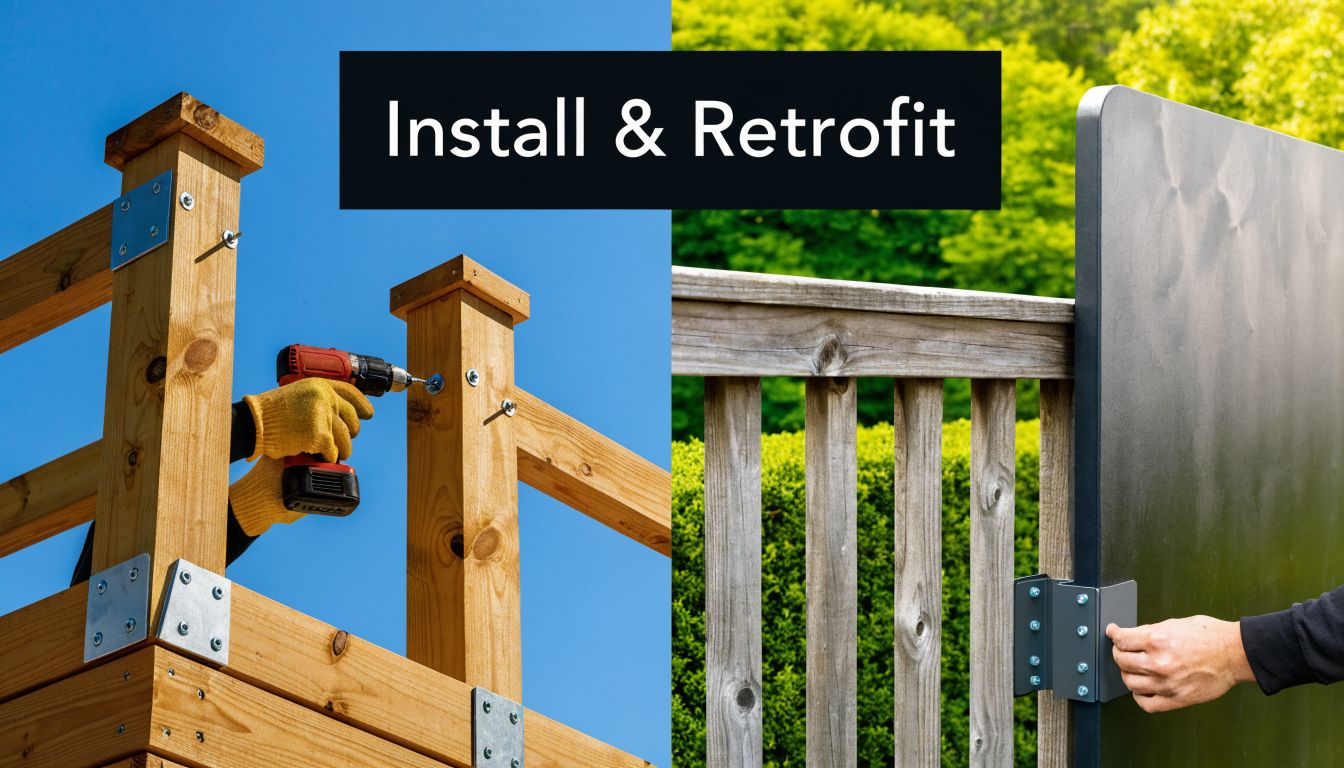
Privacy railings put different stresses on a deck than open guards. They catch wind, hold more moisture, and can rack if the posts or frame connections are weak. That's why the installation plan should change depending on whether you're building new or upgrading an existing deck.
New builds
A new build gives you the cleanest path because you can plan the privacy sections before the decking and trim lock everything in. Posts can line up with joists or framing members, blocking can be added where panels need support, and the rail layout can be designed around actual sightlines instead of whatever the old deck left behind.
For new construction, focus on these points:
- Anchor posts to structure, not just surface boards
- Add blocking where privacy panels will load the frame
- Keep spans realistic for the infill material
- Use structural screws or bolts instead of nails for primary railing joints
One reason many builders like modular metal systems is speed. Adjustable aluminium panel systems can reduce installation time by up to 40% compared with building a traditional wood lattice infill from scratch, according to installation guidance on privacy deck systems.
Retrofits
Retrofitting is where good judgment matters most. Before adding a privacy panel, inspect the existing railing posts, deck framing, and surface condition. If the current railing wobbles, adding more surface area won't fix it. It will make the weakness more obvious.
Look for:
- Loose posts
- Rot at the post base or rim area
- Undersized fasteners
- Surface-mounted rails attached only to deck boards
- Old hardware with corrosion or movement
If the structure passes inspection, then choose the lightest privacy solution that meets the goal. Decorative screens, partial panels, and framed infills often retrofit more successfully than heavy solid walls.
For added guidance on attachment methods, this article on how to attach deck railing covers the kind of connection details that matter before you start drilling into an existing deck.
Details that separate a solid build from a shaky one
Two habits make a major difference in privacy railing work.
First, support corners properly. Corners take more stress and often show movement first, especially where two screened sections meet. Extra blocking or a reinforced corner post arrangement is usually worth the effort.
Second, control panel alignment from the start. Slatted and framed systems don't hide errors well. A minor deviation at the first post turns into a visibly crooked top line by the end of the run.
A simple sequence helps:
- Set and brace posts
- Confirm plumb and top height
- Install rails or perimeter frames
- Dry-fit one infill section
- Check reveal lines
- Fasten the rest
If the existing deck can't support the added load, retrofit the structure first and the privacy panel second.
Navigating Deck Railing Codes and Safety
Privacy railing design only works if the assembly is safe. The three checks that matter most are height, spacing, and strength.
Height comes first because it determines whether the railing can function as a proper guard. In areas with stronger wind or seismic demands, code can be stricter than many homeowners expect. California requires privacy railings on raised decks to be at least 42 inches high and able to withstand specific wind loads, which is higher than the 36-inch standard used in many other places, as outlined in California privacy railing code guidance.
Spacing is the next indispensable item. Openings in the infill can't be treated as a design detail only. They're a safety issue, especially for children. Decorative screens, slats, and lattice all need to be checked against local requirements before installation.
Strength is where many attractive designs fail. A privacy panel has to stay attached and resist load, not just look square on day one. That means posts, connectors, anchors, and framing details all matter as much as the infill itself.
Why local approval still matters
Even if you've built decks before, don't assume the same rule applies everywhere. Municipal requirements, permit triggers, and inspection expectations vary. That's especially true when the railing doubles as a privacy screen or when you're changing the load on an existing deck.
If your project also includes grade changes, garden walls, or retaining features near the deck, this guide to essential legal insights for retaining wall builders is a useful reminder that outdoor structures often overlap in permitting more than homeowners think.
Frequently Asked Questions About Privacy Railings
Can I add privacy to an existing metal railing without replacing it
Yes, if the existing railing is structurally sound and the attachment method doesn't overload it. Lightweight framed panels, decorative metal inserts, or slatted screens usually retrofit better than heavy solid sheets. Check the post rigidity first. If the posts flex now, adding a screen won't solve the problem.
What's the safest privacy design for deck stairs
Stairs need extra care because the geometry changes. Railing height on stairs often needs to stay between 34 and 42 inches measured from the stair nosing, and the triangular opening under the bottom rail must be small enough that a 6-inch sphere can't pass through, according to deck stair railing code requirements. That means privacy panels for stairs usually need custom layout rather than standard deck sections cut to fit.
Is full privacy always the best choice
No. Full privacy can make a small deck feel boxed in and can increase structural demand. In many homes, a semi-private screen on the neighbour-facing side gives a better result than enclosing everything.
What hardware do people forget most often
Washers, anchors, matching corrosion-resistant fasteners, and finish pieces. Post caps get left until the end as well, even though they help protect the post top from weather.
Do privacy railings affect planning rules the same way fences do
Sometimes, but not always. The rule depends on where the railing sits, how high it is, and whether it's treated as part of a deck guard or a separate privacy barrier. If you're comparing deck screening with boundary fencing, this overview of maximum fence height UK rules is a useful example of how height limits can change by structure type and location.
If you're ready to turn deck inspiration into a real materials list, XTREME EDEALS INC. offers deck and fencing hardware such as post caps, balusters, hinges, post base brackets, joist hangers, deck screws, lag bolts, washers, and anchors that can help you source the structural and finish pieces for a privacy railing build.