

You’re probably staring at a deck plan, a shopping cart, or a pile of materials and thinking about boards, railings, stairs, and finish colour. That’s normal. Many builders focus their time on the parts they see.
The problem is that a deck seldom fails because the boards looked wrong. It fails when the structure underneath was treated like an afterthought.
Post brackets for deck posts sit low, get dirty, and don’t earn much attention. They also do one of the most important jobs on the build. They connect wood or steel posts to concrete, transfer load, resist movement, and help keep moisture from destroying the base of the post. If you get that connection wrong, every nice-looking detail above it is sitting on a weak point.
The Unsung Hero of Your Deck Project
A common DIY pattern goes like this. Someone picks a deck size, chooses pressure-treated lumber or composite boards, then starts searching hardware and finds page after page of brackets that all look similar.
Mistakes begin there.
A thin, lightly protected bracket on the wrong footing can twist, corrode, or trap moisture where the post needs to stay dry. A bracket with the wrong shape for the post can leave slop in the connection. A decorative option might look clean but still be wrong for a load-bearing support post.
The bracket is not trim. It is structure.
On deck builds, the questions that matter most come early. What is the post sitting on? How will the load travel into the footing? Is the post base holding the post up off wet concrete? Is the connector rated for the conditions where the deck is being built?
Practical rule: If a bracket only seems to solve appearance, keep looking. Structural post brackets for deck posts must solve load, moisture, and anchoring first.
If you’re comparing options before buying anything else, start with the support side of the build, not the finish side. A useful place to sort through the broader structural hardware category is this collection of deck support components.
Understanding the Main Types of Post Brackets
The right bracket depends on where the post begins. Concrete slab, pier footing, wet soil, sloped grade, and exposed deck edge all call for different hardware.
Surface-mount post bases
This bracket is frequently the first type that comes to mind. It bolts to cured concrete and holds the post above the surface.
Think of it as a shoe for the post. The concrete does the heavy work below, and the bracket creates the clean connection between foundation and wood. This is typically the right choice for deck support posts that land on piers or an existing concrete pad, provided the slab or footing is appropriate for the load.
Surface-mount bases are practical because they’re easy to inspect. You can see the anchors, the standoff, and whether water is collecting.
Embedded and cast-in-place brackets
These are installed as concrete is poured, or they’re built to integrate directly with the footing system.
They make sense when you’re building from scratch and want the connection planned into the foundation. On new work, they can be cleaner and stronger than trying to retrofit hardware later. They also reduce guesswork about anchor placement, because the base location is fixed during the pour.
Adjustable post bases
These are useful on uneven surfaces, sloped sites, or jobs where final height needs fine tuning.
Adjustment solves a real field problem. Concrete is not always perfect, and framing tolerances stack up quickly. A good adjustable bracket can help a contractor dial in plumb and elevation without shimming a support point that should never rely on improvised fixes.
Hidden and side-mount connectors
These are typically chosen when the homeowner wants a cleaner look and fewer visible fasteners.
They have their place, especially on railing work or edge details, but they are not a universal substitute for structural support hardware. Hidden hardware has to be matched carefully to its intended use. A connector that works for a rail post is not automatically suitable for a deck support post.
Comparing Deck Post Bracket Types
| Bracket Type | Best For | Installation Surface | Key Feature |
|---|---|---|---|
| Surface-mount base | Standard support posts on cured footings or slabs | Concrete | Keeps post elevated above surface |
| Embedded or cast-in-place | New footings and fresh concrete work | Wet concrete/formwork | Integrates connection into foundation |
| Adjustable base | Sloped sites or imperfect elevations | Concrete footings | Helps correct height and plumb |
| Hidden or side-mount connector | Clean visual finish in the right application | Deck framing or fascia | Reduces visible hardware |
For shoppers trying to sort the category by size and style, this range of post and fence brackets is a good way to compare common bracket formats before deciding on fasteners and anchors.
Choosing Materials for Strength and Longevity
A post bracket can fit the post perfectly and still fail early if the metal and coating are wrong for the site. I treat material choice as a service-life decision, not a finish choice, especially in California where salt air, seasonal moisture, wildfire exposure, and seismic movement all put extra stress on exterior hardware.

What different finishes do
Plain steel has no place at a deck post base outdoors. Once the surface protection is damaged, rust starts quickly, and post bases stay wet longer than many DIYers expect because they catch splashback, debris, and runoff.
Hot-dip galvanized steel is the standard starting point for many deck builds. It handles ordinary exterior exposure well and is commonly paired with pressure-treated lumber, but performance still depends on coating thickness, local moisture, and whether the bracket will spend its life near irrigation, wet soil, or ocean air.
Powder coating helps, but only when it covers a properly protected base metal. A chipped cosmetic coating over weak corrosion protection is a short-lived system.
Stainless steel costs more up front. In the right location, it saves a rebuild at the connection.
Coastal exposure changes the bracket selection
Coastal California is hard on metal. Salt, fog, wind-driven moisture, and trapped debris at the post base keep corrosion active, and that matters because the post bracket is part of the load path holding the deck down and in place.
For exposed coastal builds, use brackets and anchors rated for corrosive environments, and check the manufacturer's published corrosion and compatibility information before buying. The Fortress Evolution Beam-to-Post bracket is one example of a coated steel connector used in exterior framing. According to the manufacturer, its coating system is designed for higher corrosion resistance than untreated steel. That distinction matters because chloride attack at the base connection can reduce long-term strength where uplift and lateral forces concentrate.
Inland decks usually allow more flexibility. Near the coast, or anywhere the deck gets repeated wetting, the safer move is a more protective material system and tighter attention to connector ratings.
Material shortcut: Dry inland sites frequently support a galvanized bracket choice. Coastal, wet, high-wind, and high-exposure locations usually justify stepping up to better-protected systems or stainless steel.
Match fasteners to the bracket
A corrosion-resistant bracket paired with bargain fasteners is a common failure point. The assembly only lasts as long as its weakest metal.
Use screws, bolts, washers, and anchors that are compatible with the bracket finish and approved for treated wood exposure. For the screw side of that package, these stainless steel deck screws are a relevant option when you want corrosion resistance carried through the visible and structural hardware, not just the bracket itself.
This also affects code compliance in stricter jurisdictions. California inspectors do not care that the bracket looked heavy on the shelf if the installed hardware is mismatched, corroding, or outside the manufacturer's fastening schedule.
Decoding Loads Sizing and Building Codes
A deck can look solid on top and still fail at the base. That usually shows up after the first hard winter storm, a footing inspection, or a close look from a building official in a high-seismic area. The post bracket is one piece in a force path that has to carry weight down, resist uplift, and keep the frame from shifting sideways.
The loads that matter at the post base
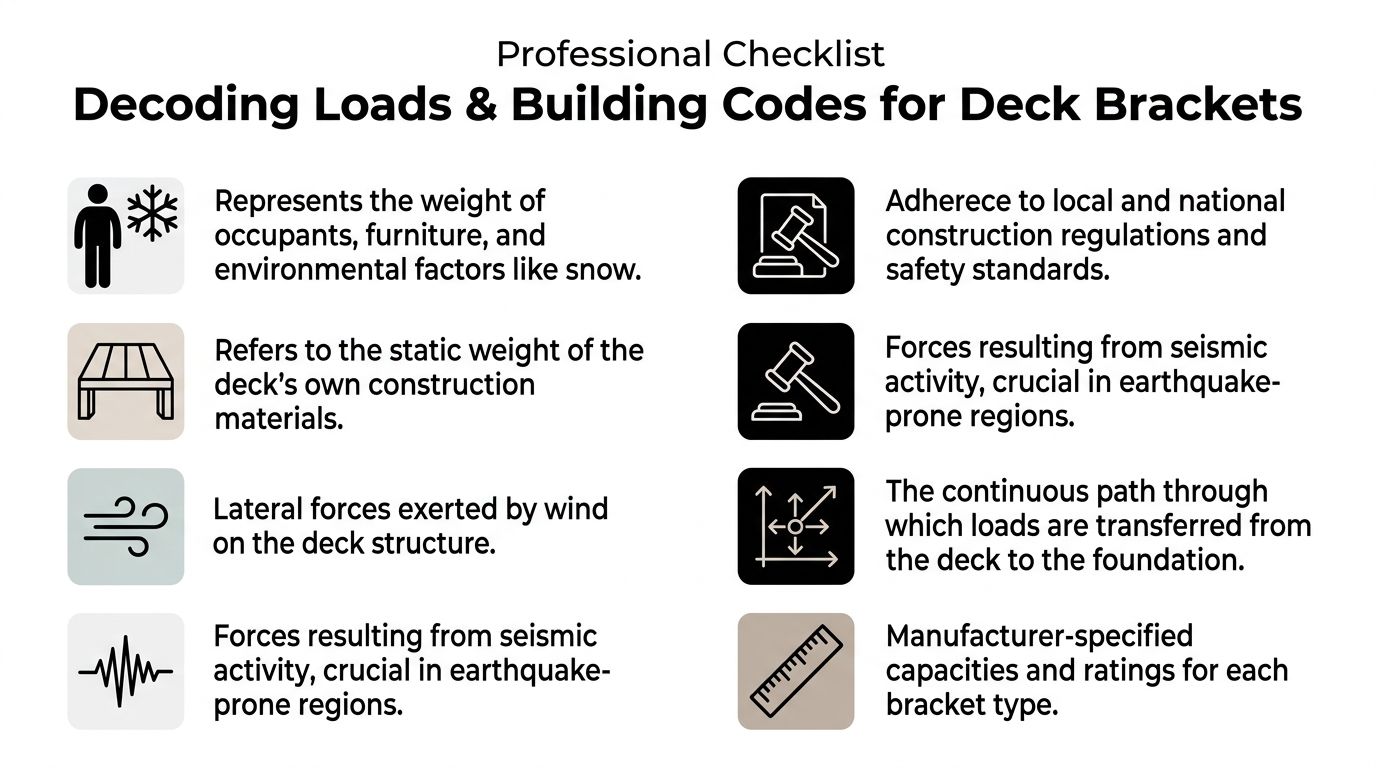
Before choosing a bracket, sort out the forces it has to resist:
- Live load is changing weight from people, furniture, and weather-related loading.
- Dead load is the weight of the deck materials.
- Uplift is the force trying to pull the post off the footing.
- Lateral load is side force that tries to rack or shift the deck.
- Load path is the continuous transfer of those forces from framing into posts, then into brackets, anchors, and footings.
If that path breaks at the base connection, the rest of the deck does not get to perform the way it was designed.
Why post size and spacing are not guesswork
Post size, post height, beam span, and post spacing all affect the bracket you can use. A light post base under a tall post in a seismic or wind-exposed site is a common mismatch.
California makes that plain. In the 2022 California Residential Code framework based on the 2021 IRC, post limits tighten quickly once lateral resistance enters the picture. The Simpson Strong-Tie deck safety guide summarizes code-driven conditions that matter to deck builders, including limits on 4×4 post use, cases where 6×6 posts are required, and post-to-footing connection demands for uplift and lateral resistance in higher seismic design categories.
That matters in the field. The bracket is not a locator that keeps the post centered on concrete. It has to match the post size, the anchor method, and the actual forces the site can see.
Wind and seismic rules change the bracket class you need
On a low backyard platform in a sheltered area, many connectors can work if they are rated correctly. On an elevated deck, a corner exposed to canyon wind, or a California site with higher seismic demand, the margin gets smaller.
Spacing also changes the calculation. Wider post spacing increases the demand on each support point, and taller posts put more strain on the base. That is why code review in California frequently pushes builders toward heavier post bases, stronger anchors, and 6×6 posts sooner than a DIYer expects. If the project sits in a stricter jurisdiction, choose a bracket with published load data and installation requirements that the inspector can verify, not a generic base with no clear rating.
XTREME EDEALS carries post base and connector options that make more sense once those site demands are known. The right move is to filter by rated application, compatible fasteners, and treated-lumber exposure, then confirm the exact connector against your drawings and local code requirements.
Fire zones add one more filter
In wildfire-prone parts of California, the base detail can trigger extra scrutiny. The local authority may care about ignition exposure near grade, non-combustible detailing around the base, and whether moisture or debris can collect where the post meets the footing.
That does not automatically change every bracket choice, but it does change how carefully the connection has to be selected and detailed.
Ask before you buy: What post size is allowed, what spacing is allowed, what uplift and lateral resistance the connection must provide, and whether the site falls under seismic, wind, or fire-zone requirements.
That check takes a few minutes. Replacing failed hardware or rebuilding a rejected support layout takes a lot longer.
Fastening and Installation Best Practices
A solid bracket installed badly is still a bad connection. Most field failures are not dramatic product failures. They are installation failures.

Start with the concrete connection
For post bases mounted to cured concrete, the anchor matters as much as the bracket body.
Wedge anchors are a common choice for heavy-duty fastening into sound concrete. Concrete screws can be useful in the right applications and are frequently faster to install, but they need the correct hole size and embedment. Adhesive and threaded rod systems can also be appropriate where the manufacturer and local code allow them.
Keep the base square to the framing layout. Check edge distance before drilling. If the anchor ends up too close to the edge of the footing, you can weaken the concrete and lose confidence in the whole connection.
Use the fastener the bracket was designed for
Do not swap structural screws for generic deck screws because they happen to fit through the hole. Do not assume a lag bolt is necessarily an upgrade. The bracket manufacturer sizes holes for specific fasteners and load paths.
Look at these basics before tightening anything:
- Hole fit: The fastener should match the bracket hole, not rattle in it.
- Corrosion compatibility: Fastener finish should suit the bracket and the treated wood.
- Length: Enough penetration to do the job without splitting the member.
- Torque: Tight enough to seat the connection, not so tight that you damage coating, strip wood, or crush fibres.
Moisture rule: A post base with adequate standoff gives the bottom of the post breathing room. That small gap is one of the simplest ways to reduce rot.
Many retrofit bases and elevated post bases use this standoff approach for a reason. Water should drain and dry, not wick into end grain sitting tight to concrete.
A quick visual demo helps if you’re new to setting bases and fastening posts:
Common mistakes worth avoiding
Some errors show up over and over:
- Mounting on weak concrete: Old, cracked, or thin slabs are poor candidates for support-post loads.
- Ignoring plumb: A bracket installed out of line forces the post to correct the mistake.
- Trapping the post in water: No standoff, poor drainage, or debris packed around the base speeds decay.
- Using mixed hardware randomly: Exterior structural hardware should act like one system, not a bucket of leftovers.
Matching the Bracket to Your Deck Project
Most buyers do not need every bracket style on the market. They need the one that fits the project in front of them.

Project A, a simple ground-level deck
Say you’re building a small backyard platform deck over an existing concrete area or over straightforward pier footings close to grade. The loads are modest, access is easy, and the goal is a durable, tidy support connection.
That job typically points toward a surface-mount galvanized post base sized correctly for the actual post. A hot-dip galvanized base for a true 3.5-inch by 3.5-inch or 5.5-inch by 5.5-inch post is the normal place to start. You want a visible standoff, good drainage, and straightforward anchoring.
Overbuilding can waste money in this scenario. You do not need specialty adjustment or heavy industrial-looking hardware if the foundation is simple and the site conditions are mild.
Project B, an elevated deck on a sloped yard
Now change the scenario. The deck is higher, the yard falls away, and the support posts land on dedicated footings rather than a casual slab edge. In this situation, bracket choice becomes more technical.
That project often needs heavier post bases, more careful anchor selection, and much closer attention to local requirements for lateral resistance, uplift, and post size. If the build sits in a demanding climate or regulated area, decorative thinking comes second.
For this type of work, some builders look at products such as cast-in-place bases, retrofit seismic-rated bases, or adjustable heavy-duty saddles. In a retail catalogue, practical examples include post base brackets and saddle-style holders sized for common wood posts. XTREME EDEALS carries options such as hot-dip galvanized post base brackets for 3.5-inch x 3.5-inch and 5.5-inch x 5.5-inch posts, plus a 13G hot-dip galvanized post support saddle bracket holder for 3.5-inch x 3.5-inch posts, which are the kinds of hardware categories worth comparing against your footing design and permit requirements.
The decision line
If your deck is low, straightforward, and sitting on sound concrete, keep the bracket choice simple but structural.
If the deck is elevated, exposed, coastal, steep-site, or code-sensitive, move out of the “looks about right” category and into rated, specified hardware.
Your Practical Post Bracket Selection Checklist
Start at the footing and work up. That is how builders avoid buying a bracket that looks right on the shelf but fails the job once load, exposure, and inspection enter the picture.
The weak point in many DIY deck plans is not the post. It is the connection at the base. In California and other high-demand jurisdictions, that choice gets tighter because wind exposure, seismic restraint, corrosion risk, and in some areas fire-related detailing all affect what hardware makes sense. Product photos do not answer those questions. Load path, footing condition, and local code requirements do.
Run through these checks before buying
- Mounting surface: Are you anchoring into a structural footing, fresh concrete, or an old slab with unknown thickness and reinforcement?
- Actual post size: Verify the true post dimensions. A nominal 4×4 does not guarantee a clean fit in every 3.5-inch bracket.
- Exposure level: Inland dry conditions, constant irrigation, coastal air, and shaded wet corners need different levels of corrosion protection.
- Required resistance: Some brackets mainly carry vertical load. Others also need to resist uplift, lateral movement, or seismic action.
- Inspection clarity: Pick hardware the inspector can see, identify, and approve without guessing what the connector is intended to do.
- Aesthetic goal: Decorative hardware is fine if it is rated for the connection. If it is not, keep it off primary support points.
A practical way to narrow it down
Use this order:
- What is the post doing? A beam support post demands a different bracket than a light screen or a stair landing post.
- What are you fastening into? A proper footing opens up structural anchor options. A patio slab typically does not.
- Will the base stay wet? If water sits at the post base, standoff height and coating quality matter more.
- What does the permit require? In seismic or high-wind areas, start with approved load capacity and installation details. Appearance comes later.
Buying discipline: Choose the bracket after you define the load, footing, exposure, and code path. That sequence prevents expensive do-overs.
What works well in practice
A useful shortlist typically includes galvanized structural bases for common deck support posts, saddle-style brackets where bearing area and stiffness matter, and adjustable bases where layout tolerances need correction without field improvisation.
For code-sensitive jobs, I look for hardware that matches the post size exactly, keeps the wood off the concrete, and accepts the specified anchors and structural fasteners without substitutions. That matters more than finish color or shelf appeal.
XTREME EDEALS carries practical categories to compare, including hot-dip galvanized post base brackets for 3.5-inch x 3.5-inch and 5.5-inch x 5.5-inch posts, plus saddle-style post support brackets for standard wood sizes. The right choice is the one that fits your footing design, fastening schedule, and inspection requirements.
Build with Confidence from the Ground Up
Decks fail from the bottom long before they fail from the top. That is why post brackets for deck posts deserve more attention than they typically get.
Choose the bracket by structure first. Match the type to the footing, the material to the environment, and the fasteners to the bracket. If your site brings seismic, wind, coastal, or fire-related demands, treat those as design inputs, not optional extras.
A clean-looking deck is satisfying. A deck that stays upright, dry at the post base, and properly anchored is the one worth building.
If you’re comparing bracket styles, post sizes, anchors, and exterior hardware for a deck or fence build, XTREME EDEALS INC. offers a practical catalogue of post base brackets, saddle brackets, fasteners, and related accessories that can help you spec the connection before you start framing.




Leave a comment
You must be logged in to post a comment.