

Let's get straight to the point, because it's the first question every builder and homeowner asks: for most residential decks in Canada and the US, if the deck surface is more than 30 inches off the ground, your guardrail needs to be at least 36 inches tall.
It's tempting to see that number as just another rule to follow, but it's better to think of it as the most important safety feature on your entire project.
Understanding the Standard Deck Railing Height Code
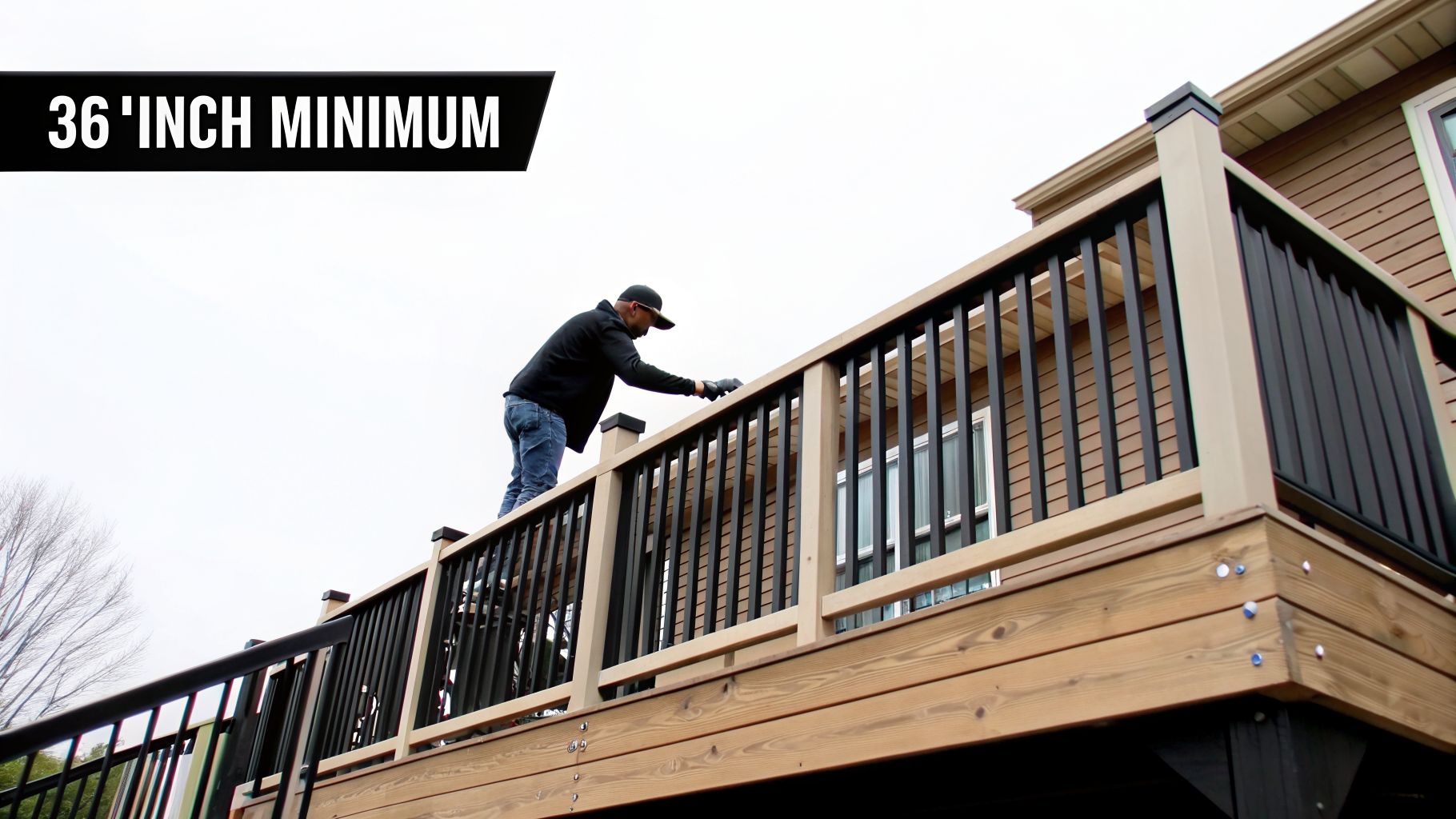
When you’re laying out a new deck, the railing system isn't just there for looks. It’s a crucial safety barrier, engineered to prevent falls and give the whole structure more integrity. Building codes are in place to set a reliable safety baseline, protecting everyone from small kids to adults. The cornerstone of all these rules is the deck railing height code.
These regulations are drawn from major national model codes, like the International Residential Code (IRC) in the United States and the National Building Code of Canada (NBCC). These documents are the blueprints that most local towns and cities use to create their own specific requirements.
Why Codes Are So Specific
Think about a seatbelt in your car. It’s designed to a specific strength and placed at a precise height for one reason: to work when you need it most. A deck railing is exactly the same. That 36-inch minimum height isn't some random number—it's been calculated to be just high enough to stop an average-sized adult from accidentally tumbling over the edge.
That same practical logic applies to the other critical number: the 30-inch (or 76 cm) rule. If your deck's walking surface is less than 30 inches from the ground (what inspectors call "grade"), codes often don't require a guardrail at all. The thinking here is that the risk of a serious injury from a fall below that height is significantly lower.
Key Takeaway: The 30-inch mark is the trigger. If any part of your deck is higher than 30 inches off the ground below it, a full-height guardrail is mandatory. You measure this straight down from the edge of the deck surface to the ground.
Of course, just because code doesn't require a railing on your low-profile deck doesn't mean you shouldn't build one. A fall onto a hard-packed lawn or a stone patio can still cause an injury. Adding a railing is a smart upgrade that provides a lot of peace of mind, especially if you have young children or elderly family members using the deck.
To get a railing that's not just compliant but truly solid, you have to look beyond the height. The entire system has to function as one. This is where choosing the right hardware makes all the difference. Products like our heavy-duty post base brackets and structural screws are specifically engineered to anchor posts securely, ensuring your finished railing can handle the real-world forces specified in building codes.
For a clearer picture, this table sums up the most common residential deck railing codes you'll encounter.
National Deck Railing Code Requirements at a Glance
Here’s a quick summary of the most common residential deck railing height and spacing codes based on national models like the IRC and NBC.
| Code Element | Standard Requirement | Primary Purpose |
|---|---|---|
| Minimum Guardrail Height | 36 inches (914 mm) | Prevents accidental falls over the top rail for decks over 30 inches high. |
| Baluster Spacing | Openings must not allow a 4-inch sphere to pass through. | Prevents small children from squeezing through the railing. |
| When a Guardrail is Required | Decks more than 30 inches (762 mm) above grade. | Addresses the increased risk of injury from higher falls. |
Keep these core numbers in mind as you plan, and you'll be well on your way to building a deck that's as safe as it is beautiful.
Guardrails and Handrails: What Builders Need to Know
In the world of deck building, getting your vocabulary right matters more than you’d think. A lot of builders and homeowners use the terms ‘guardrail’ and ‘handrail’ interchangeably. It’s a common mix-up, but one that regularly leads to failed inspections, frustrating delays, and costly rework.
Understanding the critical difference between these two safety features is fundamental to any successful deck project.
Simply put, a guardrail is the main protective barrier along the open sides of your deck. Its one and only job is to prevent falls. Think of it as the fence at a scenic lookout—its entire purpose is to stop someone from accidentally going over the edge. This is why its requirements are all about height and strength; the deck railing height code demands a minimum height, like 36 inches, for any deck more than 30 inches off the ground.
A handrail, on the other hand, does a completely different job. It’s a support rail made specifically for stairs, giving you a stable surface to grip as you walk up or down. Its design is all about graspability and proper placement, not just preventing a fall from the side.
Key Functional Differences
The easiest way to keep them straight is to connect each term to its location and purpose. Guardrails are for perimeters; handrails are for stairs.
- Guardrails: Their job is to create a protective wall. Codes focus on things like minimum height (e.g., 36 inches), the ability to withstand force (a 200-pound load), and the spacing of the balusters (the 4-inch sphere rule).
- Handrails: Their job is to provide stability. Codes for handrails zero in on a specific height range (usually 34 to 38 inches from the stair nosing) and a continuous, easy-to-grip surface.
This distinction directly affects the parts you need to buy. A guardrail needs beefy post anchoring to handle serious side-to-side force. For that, you’ll need heavy-duty hardware and structural fasteners to build a rigid, safe barrier. A handrail, however, uses specialized brackets that position the rail correctly for an easy grip along the slope of the stairs. Using the wrong hardware is a guaranteed way to fail your inspection.
A guardrail is like a hockey rink’s boards—it’s there to stop high-impact force. A handrail is like a walker—it’s there for continuous support and balance. One protects, the other assists.
Sourcing Materials for Each Application
When you're building, you have to treat these as two separate systems. If your deck includes stairs, you'll need both a guardrail system for the deck's perimeter and a separate handrail system for the stairs themselves.
The guardrail on the stair section still has to meet the height and spacing rules, but you must also add a graspable handrail if the staircase has four or more risers.
For builders who want a deeper dive into how these codes work in the real world, checking out professional custom deck construction services can give you great insight into compliant building practices. Seeing how pros integrate these distinct systems on complex projects makes it all click.
For your project, this means picking strong 4×4 posts for the guardrail and making sure they’re secured with the right bolts and anchors. Our Post Base Brackets are designed exactly for this purpose, providing a secure foundation for your guardrail posts. For the handrail, it means choosing a rail profile that’s easy to grip and mounting it at the correct ergonomic height. Mixing these two up isn’t just a technical mistake; it’s a major safety liability.
How to Measure Railing Height for Code Compliance
Getting the measurement wrong is one of the fastest ways to fail a deck inspection. It’s a simple mistake, but one that can lead to expensive, time-consuming fixes. Understanding how to measure your deck railing height isn't just about following the rules; it's about making sure your project is safe and gets the green light from the inspector on the first try.
The process itself is straightforward, but a few common pitfalls can easily trip up even a seasoned DIYer. The golden rule is to measure vertically from the finished walking surface of your deck right up to the very top of the rail. Picture yourself standing on your newly installed deck boards—the measurement starts at your feet and goes straight up.
The Correct Starting Point for Your Measurement
The single most important part of getting this right is identifying your starting point. The building code is crystal clear on this: you must measure from the surface people will actually walk on.
A classic mistake is measuring from an unfinished surface. For example, if you measure from the deck joists before the decking boards are down, your final railing will be too short by the thickness of those boards. That's an automatic inspection failure.
Here are a few common measurement mistakes to avoid:
- Measuring from the joists: This ignores the thickness of your decking, leading to a railing that doesn't meet the height requirement.
- Measuring from the ground under the deck: Your measurement has to start from the deck surface itself, not the yard below.
- Measuring at an angle: Always hold your tape measure perfectly vertical (plumb) to get a true height reading. A slanted measurement will give you a false, longer number.
This chart helps clarify the different roles and measurement points for guardrails and handrails.
As you can see, guardrail height is measured from the flat walking surface of the deck, while handrail height is measured differently, following the slope of the stairs.
The 30-Inch Rule: When Is a Railing Required?
Before you even worry about the railing's height, you need to figure out if you're required to install one at all. This is where the crucial "30-inch rule" comes into play. Building codes state that a guardrail is mandatory on any deck that is more than 30 inches above the ground (or "grade") at any given point.
To check, grab your tape measure and head to the outer edge of your deck frame. Measure straight down from the deck's edge to the ground directly below. If that number is over 30 inches anywhere around the perimeter, you are required by code to install a compliant guardrail.
Key Takeaway: The 30-inch rule is a hard line. Even if just one corner of your deck is 31 inches high because of a slope in your yard, the entire open-sided perimeter of the deck must have a guardrail.
Some jurisdictions take this threshold even more seriously. Local codes can and do vary, so it always pays to check with your municipal building department to see what specific rules apply to your project.
Getting the measurement right is step one, but securing the railing properly is just as critical. For a complete walkthrough on creating a strong, stable connection, you can learn more about how to attach deck railing posts in our detailed guide. With the right measurements and a sturdy installation, your deck will be both safe and code-compliant.
Navigating Local Code Variations and Exceptions
While national building codes like the IRC provide a solid baseline, think of them as the starting point, not the finish line. The single most important rule in any deck project is this: your local building department has the final say. The safest way to approach any job is to treat the national code as a "suggestion" and your local code as the "law."
Municipalities often tweak national codes to deal with specific local issues. Ignoring these differences is a surefire way to fail your inspection, forcing you to tear down your hard work and start over. Before buying a single post or baluster, you must verify the exact rules for your specific area.
Why Local Deck Railing Height Codes Differ
It's easy to wonder why there isn’t just one universal standard. The reality is that local governments modify deck railing height codes for very good safety reasons, often tied to geography, climate, and how a building is used.
Here are a few common reasons for local changes:
- High-Wind Zones: If you live in a coastal area or a region known for extreme weather, codes may demand taller and stronger railings simply to withstand powerful wind loads.
- Multi-Story Buildings: Apartment buildings, condos, and commercial properties almost always face stricter requirements. It's common to see guardrail heights pushed to 42 inches or more for the added safety needed on upper floors.
- Specific Occupancy Use: A deck at a busy restaurant will have much more stringent rules than a private, single-family home's deck because of the increased foot traffic and liability.
Taking the time to call your local building office isn't just navigating red tape; it's the best insurance policy against costly mistakes. That one phone call can save you thousands of dollars and a massive headache.
California: A Case Study in Stricter Codes
To see just how much local rules can change the game, you only need to look at California. The state enforces a 42-inch deck railing height requirement under the California Building Code (CBC), which is one of the toughest residential deck standards in the country.
While the IRC sets the minimum at 36 inches for most of the U.S., California mandates an extra 6 inches of height for fall protection. For contractors and DIYers in California, this is a critical detail—building to the common 36-inch standard will guarantee a failed inspection. You can find more details on these specific rules through local deck safety resources.
That 6-inch difference has a huge impact on your material list. It means you have to source railing posts, panels, and systems specifically designed and rated for a 42-inch height. Our online store makes this easy by offering a wide selection of heavy-duty post base brackets and hardware strong enough to support these taller, heavier guardrail systems, making sure your structure is built right and fully compliant.
Exploring Code Exceptions Like Built-In Seating
Even with all these strict rules, some codes do allow for clever exceptions if they're built correctly. One of the most common examples is built-in seating along the edge of the deck.
Some local codes permit built-in benches to serve as part of the guardrail system, but only if the bench meets specific dimensional requirements—typically, the seat must be a certain depth and the seat back must still reach the required guardrail height (36 or 42 inches).
This is one area where you absolutely must get clear approval from your local inspector before you start building. Never assume it’s allowed. If you build it incorrectly, an inspector will likely make you tear it all out and install a standard railing—a frustrating and expensive setback. Always get an official sign-off on your plans first.
Meeting Spacing, Load, and Infill Requirements

Getting your deck railing height right is a huge first step, but it’s far from the whole story. A truly compliant railing is about more than just a single measurement. Building inspectors are trained to look closely at the structural details—the things that make a railing a life-saving barrier instead of just a decorative fence.
Two of the most critical rules you’ll encounter are the "4-inch sphere rule" for infill and the 200-pound load requirement. Think of them as two sides of the same safety coin. One rule keeps small children from squeezing through, while the other ensures the entire system can stop an adult from falling over the edge.
The Unbreakable 4-Inch Sphere Rule
This is one of the most non-negotiable standards in residential building codes, and for good reason. It states that the gaps in your guardrail, like the spaces between balusters, must be small enough that a 4-inch diameter sphere cannot pass through. Why four inches? That’s widely considered the maximum space a toddler’s head can’t fit through, making this a critical child safety feature.
This rule doesn't just apply to the space between your vertical spindles. You have to check every opening:
- The space between each vertical baluster.
- The gap between the bottom rail and the surface of your deck.
- The space between a post and the first baluster.
It’s crucial to plan for this from the very beginning. For a closer look at how to get this right, check out our guide on how to build a deck with balusters. A little planning here goes a long way toward a beautiful and, more importantly, safe final product.
Meeting Structural Load Requirements
Beyond the spacing of your infill, your railing has to prove it’s strong enough for the real world. Codes demand that a guardrail can withstand a specific amount of force without breaking or bending too far. This is the load requirement, and it’s arguably the most important structural test your railing will ever face.
The standard code requires a guardrail to resist a 200-pound concentrated force applied at any point along the top rail, in any direction. Picture an adult stumbling and throwing their full weight against it—the railing must hold. This is where your choice of hardware becomes non-negotiable.
A railing built with undersized fasteners or improper connections is a safety hazard waiting to happen. It might look secure, but under a sudden load, it can fail catastrophically. The strength of your railing is only as good as its weakest connection point.
This is why safety requirements, like those in California, go beyond just height. They combine the maximum 4-inch spacing for balusters with the mandate that railings withstand a 200-pound lateral load. This creates a complete safety system.
So how do you achieve that kind of strength? It all comes down to the hardware. To meet these load tests, you need to use products specifically engineered for the job. Our Post Base Brackets create a rock-solid foundation, while properly sized lag bolts and structural screws ensure every connection can handle the forces laid out in the building code. This isn’t about over-engineering; it’s about building a structure you can trust to keep your family and guests safe.
Your Deck Compliance Checklist and Product Guide
Trying to sort through all the deck railing height codes can feel like a real headache. The good news is, if you break it down into a few manageable steps, it becomes a straightforward job. I've put together a checklist that turns those abstract rules into a solid action plan for your project.
To make things even simpler, I’ve matched each step with some product ideas. This way, your safety checklist doubles as a shopping list, helping you build a deck that not only looks fantastic but also sails through its inspection.
Step 1: Confirm Your Local Height Code
Before you even think about buying materials, your first call should be to your local building department. It's a crucial first step. While the national codes provide a baseline—often a 36-inch minimum railing height—your local municipality might have stricter rules. For example, some areas in California mandate a 42-inch height.
- Action: Jump on your municipal building office's website or give them a call. Get the exact deck railing height code required for your specific address. Don't guess.
- Product Focus: Once you have that magic number, you can start picking out materials. Keep in mind, taller railings need more robust support, which brings us right to the next step.
Step 2: Secure Your Foundation
The real strength of your railing isn't in the rail itself, but in how it's anchored. Every single post has to be fastened securely enough to withstand a 200-pound load test. A wobbly post connection is, without a doubt, the most common reason a deck fails inspection.
- Action: Always choose post anchors and fasteners that are specifically rated for structural loads. Never just rely on a few screws driven into the thin rim joist—that’s a recipe for failure.
- Product Recommendation: Our heavy-duty post base brackets are designed to create a rock-solid connection between your post and the deck's frame. For the best results, pair them with our structural screws or lag bolts. This ensures the post is tied directly into the stronger joist framing, creating a rigid system that goes above and beyond code requirements.
Step 3: Verify Baluster Spacing
After checking the height and post strength, an inspector’s next move is to check the spacing of your infill. They'll use what's known as the 4-inch sphere rule, and it's non-negotiable. This is one of the most important safety features on your deck, designed to protect small children and pets.
- Action: When you're laying out your railing, make sure no gap—whether it’s between balusters, between a post and a baluster, or between the bottom rail and the deck surface—is large enough for a 4-inch sphere to squeeze through.
- Product Recommendation: We carry a wide selection of metal and wood balusters that make it easy to get this spacing right while adding some style. For an all-in-one solution, check out our complete deck rail kits for Canadian homeowners.
Following these steps takes all the guesswork out of building a compliant deck railing. When you match the right products to each specific code requirement, you’re building safety and quality into your project right from the start.
Step 4: Choose Your Finishing Touches
Building to code doesn't mean you have to build something boring. Once all the structural parts are in place, you can add those final touches that protect your investment and give your deck a polished, professional look.
- Action: Look for accessories that will shield your posts from rain and snow while adding a bit of character.
- Product Recommendation: Our decorative post caps are the perfect way to finish the job. They come in pyramid, ball, and other styles, but they do more than just look good. They protect the vulnerable end grain on top of your posts from moisture, which helps prevent rot and extends the life of your entire railing. Best of all, they just slide right over standard posts without affecting your height measurement.
Frequently Asked Questions About Deck Railing Code
Even with the most careful planning, it’s only natural for a few tricky questions to pop up when you’re building a deck. Let's tackle some of the most common ones that we hear from builders and homeowners. Getting these sorted out now can save you a lot of headaches down the road.
What Happens If My Deck Railing Fails Inspection?
Failing a deck inspection is a scenario everyone wants to avoid. If your railing doesn't meet the code, the inspector will hand you a correction notice. Think of it as a to-do list you didn't want, detailing every single violation—maybe the railing is too short, the balusters are too far apart, or a post feels a bit wobbly.
From there, you’ll have to fix every issue on the list before scheduling a re-inspection, which usually comes with another fee. This doesn't just hit your wallet; it can bring your entire project to a standstill. Getting the deck railing height code right the first time is simply the best way to save time, money, and stress. If you want a better sense of what inspectors look for, a good house inspection checklist can be a great resource for understanding safety standards across the board.
Can I Use Horizontal Cable Railing and Still Be Compliant?
Absolutely. Horizontal cable railings are a very popular choice and are compliant in most areas. They offer a sleek, modern look that many people love. However, you need to do your homework here, as some local building departments have put restrictions on them because of the "ladder effect"—the concern that young children could use the horizontal cables to climb.
The secret to a compliant cable railing is all about the tension. Your cables must be tightened enough that a 4-inch sphere can't squeeze through at any point. Before you go all-in on a cable system, your first step should always be to double-check with your local building inspector to make sure they're allowed in your area.
Important: Just running the cables isn't good enough; they have to be properly tensioned to pass. Investing in quality tensioning hardware is non-negotiable for getting it right and keeping it safe for years to come.
Do I Need a Railing on a Low-Level Deck?
The building code is pretty clear on this one. If the surface of your deck is less than 30 inches above the ground at every point, you generally aren't required to install a guardrail.
But just because you don't have to, doesn't mean you shouldn't. We strongly recommend adding a railing anyway. A fall from any height can lead to injury, particularly for small children or older adults. It’s a relatively small investment that adds a huge amount of stability and peace of mind for everyone who enjoys your deck.
Whether you're building a high-off-the-ground deck that needs a full guardrail or a low-profile one where you’re adding a railing for that extra measure of safety, the right hardware is key. For a rock-solid foundation, our heavy-duty Post Base Brackets provide the structural support you need for a strong, dependable railing system.
At XTREME EDEALS INC., we provide all the high-quality fasteners, brackets, and accessories you need to build a safe, stylish, and code-compliant deck. Explore our full range of deck hardware at https://www.xtremeedeals.ca.







Leave a comment
You must be logged in to post a comment.